التصنيف: غير مصنف

  • The True Cost of Getting Cancer in Your 20s, 30s, and 40s

    The True Cost of Getting Cancer in Your 20s, 30s, and 40s


    Rebecca Siegel still remembers the moment it started — a flash of data on her computer screen that stopped her cold.

    It was 2008, and Siegel, then a young epidemiologist at the American Cancer Society, was preparing a report on colon cancer. Since regular colonoscopies became routine for people over 50 in the 1990s, colon cancer had been a point of pride in the gloomy world of cancer news. Tumors were caught sooner, and pre-cancerous polyps could be removed before they turned deadly.

    On a whim, Siegel pulled up the data for people under 50. What she saw shocked her: More than 10,000 people in their 20s, 30s, and 40s had been diagnosed with colon cancer that year. The number was relatively small, but it had been climbing steadily for over a decade.

    Rebecca Siegel
    Rebecca Siegel, now Senior Scientific Director of Cancer Surveillance at the American Cancer Society, in her office in Atlanta. Alyssa Pointer for BI

    “This is big,” Siegel remembers thinking. “Something changed.”

    She was right, though it would take another decade before the medical community took action. In 2018, the American Cancer Society recommended lowering the age for colon cancer screening to 45, spurred in large part by Siegel’s work.

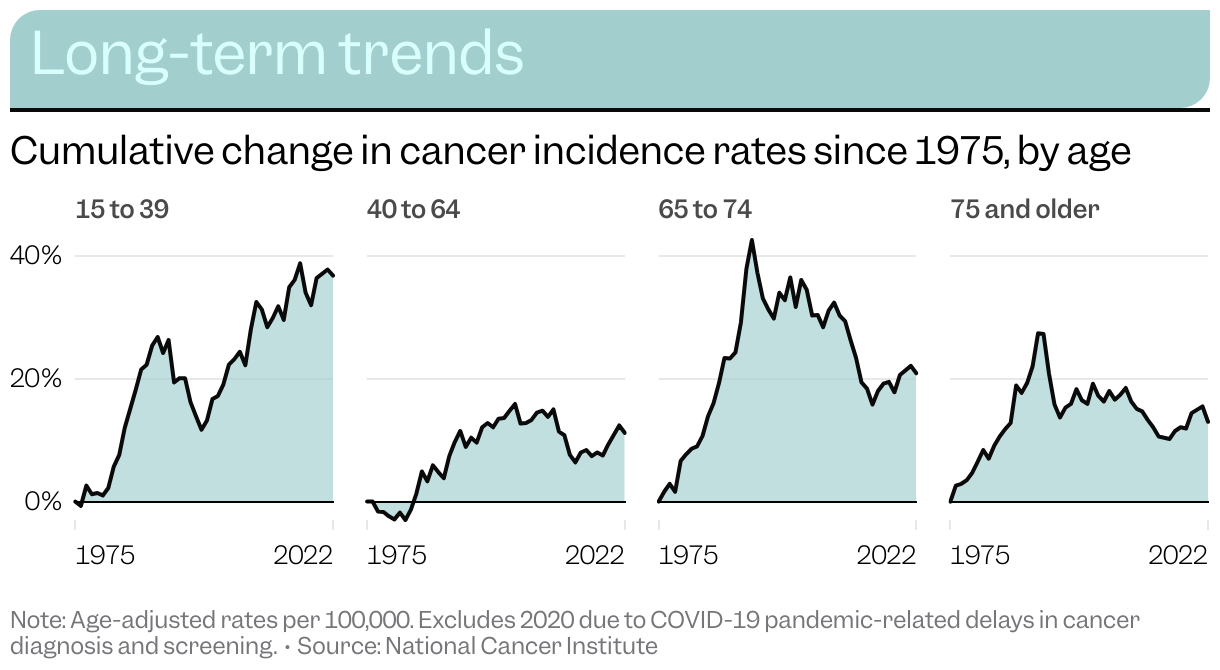
    Long-term trends (Small multiple line chart)

    The development put “young cancer” at the top of the agenda. Researchers and clinicians started interrogating data for other cancers, asking if our modern lifestyles were driving an “early-onset cancer epidemic,” as one paper put it. Scientists noted an uptick in cervical cancer among women in their 30s, and more stomach cancer and melanoma in people in their 40s. Cancer centers focused on patients under 50 began to sprout up at hospitals across the country.

    Is it an “epidemic” driven by modern life? The real answer is a little stickier. Some young cancer diagnoses can be explained by lifestyle, and others are due to more detection. Advances in genetic testing and the increased use of MRIs have allowed us to catch more cancer much sooner. Still, experts say screening can’t explain everything. Something mysterious does seem to be driving up cases of colon cancer.

    Rebecca Siegel
    Siegel’s research on young colon cancer is partly responsible for the US lowering the age of colonoscopies to 45 years old. Alyssa Pointer for BI

    Whatever the cause, the costs are enormous.

    Most people in their 20s, 30s, and 40s don’t have the kind of nest egg, pension, or Social Security checks that an older patient might have. Nor do they have Medicare. If they’re insured through work, keeping their job is essential to ensure treatment. A young cancer diagnosis will cost a person, on average, $250,000 over a lifetime, according to one 2021 report by Deloitte. Many will go bankrupt or empty their retirement savings just to keep up with the costs of care.

    The crisis doesn’t just fall on the individual — it’s reshaping the entire healthcare ecosystem. This year, employer-based healthcare premiums are up 9%, the largest increase in more than a decade. While weight-loss drugs are a big part of that, 88% of employers rate cancer as their biggest healthcare cost concern. Even if you don’t have cancer, you’re paying for it.

    Business Insider has been tracking this all year. We’ve reviewed hundreds of studies and interviewed leading oncologists, epidemiologists, medical directors, and research scientists, as well as caregivers, startup founders, and economists. We’ve spoken to dozens of people living with young cancer.

    Our reporters kept hearing the same thing from patients: “I can’t afford to be sick.”

    The bottom line is that more Americans in the prime of their lives, with careers, mortgages, and kids, are navigating cancer treatment. It’s incredibly stressful, destabilizing, and financially perilous for them, and it’s also impacting our entire healthcare system.


    A lot of the young people getting cancer today are part of the “avocado toast” generation.

    They’re the test case for a health system built on personal responsibility. Expected to make smart decisions about their health — eat healthy, get plenty of exercise, avoid cigarettes and alcohol — they’ve also been saddled with more student debt, less job security, and ballooning housing costs.

    They’re also the test case for how we tackle rising cancer rates among younger people. Millennials are now twice as likely to test positive for colon cancer during their lifetime as their chain-smoking, steak-eating grandparents. They’re four times more likely to be diagnosed with rectal cancer. And millennial women are more than twice as likely to get a uterine cancer diagnosis as their grandmothers were, federal statistics show.

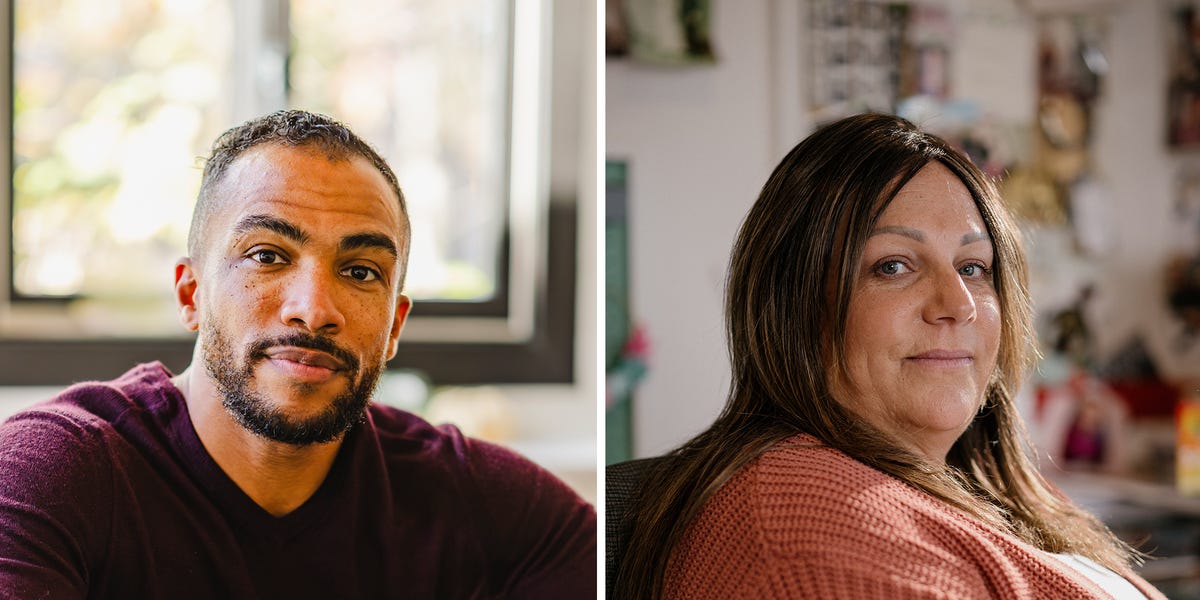
    Take John B. Johnson, a 37-year-old brand consultant in Cleveland.

    John B. Johnson
    John B. Johnson was diagnosed with stage 2 colon cancer weeks before his wife learned she was pregnant with their second child. Ryan Gryzbowski for BI

    Two years ago, Johnson considered himself to be in the best shape of his life. He ate a plant-based diet and had qualified for the Boston Marathon. He and his wife had an 18-month-old girl. In a few weeks, they’d get the news that a baby boy was on the way.

    When Johnson spotted what looked like a drop of red food dye in the toilet, he chalked it up to the beets he ate regularly. But it kept happening. The days after learning he had stage 2 colon cancer were a blur. After years of limiting carcinogenic nitrates and alcohol, Johnson remembers devouring barbecued meat, washed down with tequila, and questioning everything. “I think it was a valid response to finding out that you had cancer, but it wasn’t a helpful response,” he says.

    Like one in 10 Americans, Johnson was also his own boss. He runs a small design agency with a handful of junior employees.

    He had health insurance through his wife’s employer, but no paid leave or back-up leadership. When he didn’t work, projects stalled, and there was no one pitching new clients.

    John B. Johnson
    Like 10% of Americans, Johnson is self-employed. He timed his chemo so that his worst side effects would fall on weekends. Ryan Gryzbowski for BI

    To keep his business afloat, Johnson planned his chemotherapy so that the worst side effects would strike over the weekend. Every other Wednesday for four months, Johnson would start his slow-drip of chemo. If he was lucky, the most intense bouts of nausea wouldn’t begin until Friday afternoon. “Through the weekend, I was pretty much out of it,” Johnson says. The routine allowed Johnson to return to work every Monday.

    This meant his wife took the brunt of childcare. When their son was born a month and a half after Johnson finished treatment, he took just one week off from work.

    Even as his company lost business, he was able to keep things afloat. “It did get really close to failing,” especially toward the end of his treatment, he says. “The month that I found out the cancer was gone, we were at $0, and it was not looking up.”

    For six months, he didn’t cut himself a single paycheck. He says it’s “almost a miracle” he’s still in business today.

    Johnson laments that there really isn’t much in the way of support for small business owners with cancer. He wishes there were grants or other programs to help ease the burden.

    Ever optimistic, Johnson looks back on his treatment as a challenge that pushed him to be better. “It made me a better business owner, made me a better leader,” he says. “But I wonder: what if I had a little bit of support?”


    As employers confront the rising costs of cancer treatment, a wave of startups is stepping in, promising to streamline care, cut costs, and improve outcomes for employees.

    One of the biggest players in this $130 billion sector is Color Health, a virtual clinic that offers end-to-end cancer care, from genetic testing and screenings to oncology appointments and after-care. The goal is to detect cancer sooner and coordinate treatment more efficiently, saving money for employers and time for patients.

    Color’s success is proof that the situation has become “untenable” for employers, says Othman Laraki, Color’s CEO and cofounder, who was previously a product lead at Twitter and Google. Its partners include United Airlines, Red Bull, and toymaker Hasbro, and the company has seen a fivefold increase in patients this year.

    “I think it really does start with managing cancers early and proactively,” Laraki says.

    Erica Hoffman
    Erica Hoffmann said the benefits she got through work at Red Bull were a lifeline. She’s not sure how her health would be without her job. Ian Tuttle for BI

    Erica Hoffmann, a 49-year-old distribution manager for Red Bull in the San Francisco Bay Area, received genetic testing through Color in her early 40s. She learned she was at high risk of developing breast and pancreatic cancers. Her mammograms came up clean, and Hoffmann and her doctors went back and forth about preventive surgery.

    When her husband was diagnosed with bladder cancer at 60, her first thought went to the couple’s 10-year-old daughter. “Your husband has cancer, you can’t get cancer,” a friend told her. Hoffmann scheduled a preventive mastectomy.

    The surgery seemed to go well. Afterward, an aggressive stage 1 tumor was discovered in tissue from her right breast.

    During the first half of 2025, Hoffmann and her husband were in chemotherapy. “It was go time,” she says of the survival state they lived in, amid the brain fog, nausea, and exhaustion. “You just go and do the best you can.”

    For all the hardship, Hoffmann had a lot going in her favor.

    Erica Hoffman
    Hoffmann said her work was a lifeline, though keeping up with the day-to-day between treatments was exhausting. Ian Tuttle for BI

    She and her husband hit their deductible almost immediately, so their insurance covered nearly all treatment costs. Through the state, she was eligible to take 19 days of short-term disability. Red Bull also provided Hoffmann with a nurse navigator, through a company called Lantern, to help set up appointments for Hoffmann and her husband and reduce the paperwork that came with organizing cancer care.

    Color set her up with a nutritionist to help her shed some of the weight she gained during treatment, since it’s a risk factor for the cancer to come back.

    “I’ll be honest with you. Had I not been with Red Bull, I don’t think my husband and I would be doing as well,” she says.

    The couple’s community also rallied. Coworkers sent flowers and gift cards, and friends dropped off food. When it became impossible to drive Hoffmann’s daughter to soccer practice — once a highlight of her day — a friend from a women’s group stepped up. A neighbor, whom the couple had hardly known before their diagnoses, began showing up once a week to tidy up their home and do laundry, no questions asked.

    She’s glad they already had life insurance when they were diagnosed. Their rate is locked in, assuming they never miss a monthly payment. Young people who want to buy a life insurance policy after a cancer diagnosis are likely to pay more and might be denied outright.

    Today, Hoffmann is out of the woods, at least for now. But she worries about secondary cancers, especially pancreatic cancer, which runs in her family, and the chance that their daughter will get sick one day, too.

    “I’m very scared,” she says. “I am constantly thinking the worst.”


    Figuring out which genes, life events, and environmental stressors fuse to create cancer — and how best to treat it — has fueled a big market.

    Genetic testing companies sell $1,000 blood tests, such as Galleri, and Prenuvo offers full-body scans for $2,500.

    Some researchers, including Siegel, warn those aren’t the cheapest — or even the best — solutions. As cancer becomes a reality for more people in the prime of their lives, it’s crucial that we discern who needs a test and when, Siegel says. “So you’re diagnosing cancers that are higher-risk and are more likely to cause death,” she adds.

    While many things about cancer remain mysterious, there is a lot that we do know.

    Research papers
    Nearly two decades after identifying a mysterious rise in young colon cancers, Siegel is still trying to find reasons for the uptick. Alyssa Pointer for BI

    Many cancers can be largely explained by our lifestyle. For example, researchers have found that 60% of endometrial cancers are due to excess body weight. There are clear links between breast cancer and alcohol, as well as both risks and benefits of later first pregnancies.

    There is clear evidence that some habits — a diet rich in fiber and whole grains, as well as coffee, vitamin D3, and regular exercise — can help reduce the risk of cancer by lowering inflammation, among other benefits.

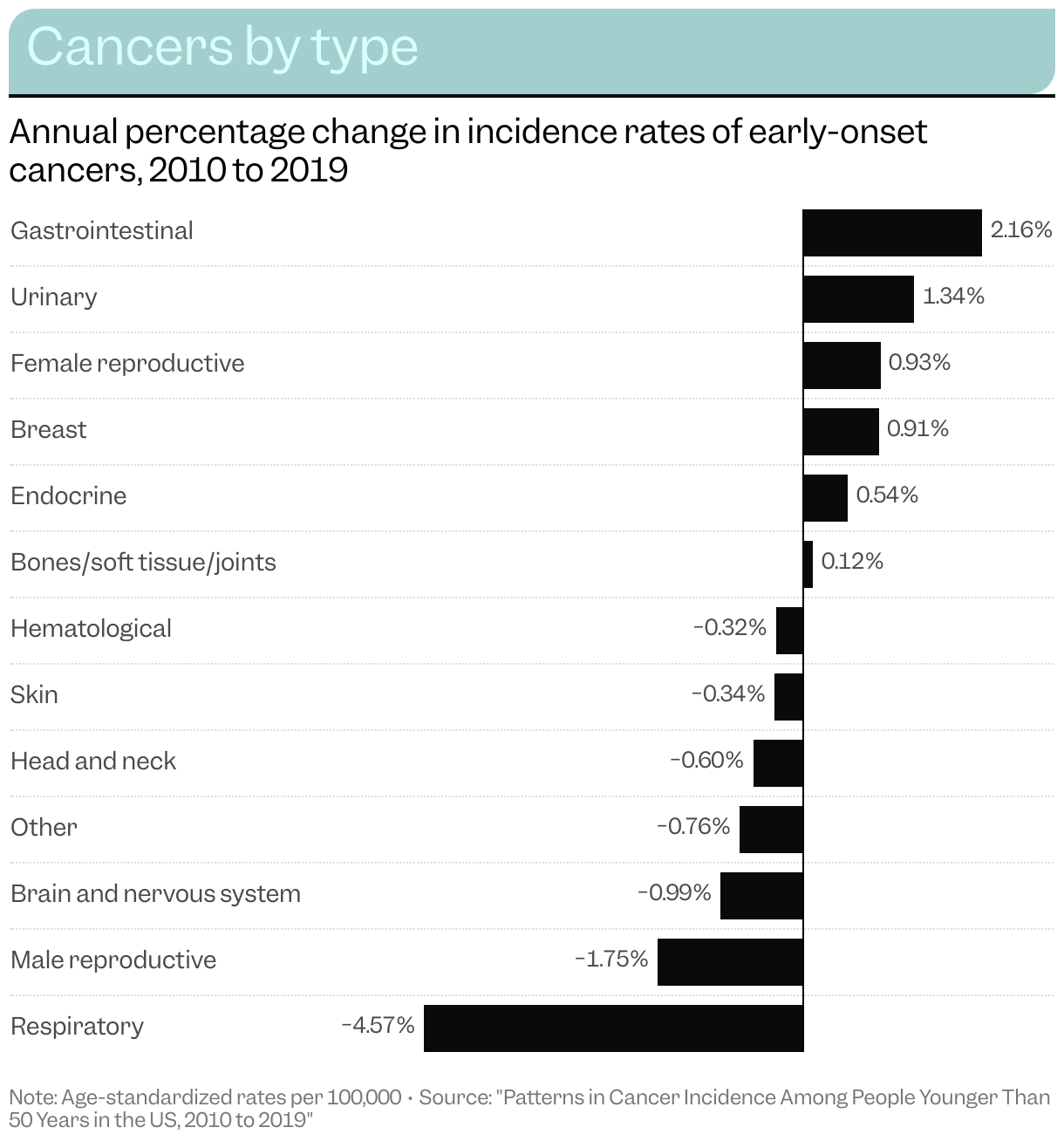
    Cancers by type (Bar Chart)

    There are some harder-to-pinpoint aspects of modern life, which may be driving colon cancer specifically. Researchers cite ultra-processed diets, air pollution, microplastics, artificial light, antibiotics, and sedentary lifestyles as possible factors, even if they’re only part of the story. Some researchers studying colon cancer are homing in on the gut microbiome.

    As Yin Cao, a leading colon cancer researcher, put it: “You need a more system-wise change in what they are breathing, they’re eating on a daily basis.”

    For now, the fixes — both for the biology and the economics — fall on the individual. Have “good” insurance. Get secondary insurance. Eat a clean, often costlier and less convenient, diet. Consider preventive testing. Deal with the long-term damage, the secondary cancer risks, poor fertility, and higher life insurance premiums.

    John B. Johnson
    Johnson wants to make sure that he’s in the best shape of his life — physically, financially, and mentally — if he does get cancer again. Ryan Gryzbowski for BI

    After Johnson, the Ohio business owner, completed his treatment, he got back into the groove of his life. He launched Get off My Butt, a foundation designed to dispel the stigma around seemingly embarrassing colon cancer symptoms.

    He’s still worried about cancer coming back. As a survivor, he’s at a heightened risk of getting colon cancer — or some other cancer — again. But he wants to make sure that, if it does, he’ll be in the best shape of his life — physically, financially, and mentally.

    In April, he finally got to run the Boston Marathon. His running partner was his surgeon.


    Business Insider’s Discourse stories provide perspectives on the day’s most pressing issues, informed by analysis, reporting, and expertise.


    Source link

  • I’m a Gen Xer, and I’m Glad I Grew up in an iPhone-Free World

    I’m a Gen Xer, and I’m Glad I Grew up in an iPhone-Free World

    I went to see Oasis this fall after buying expensive, last-minute tickets in the nosebleed seats.

    It was great, but my husband and I paid $275 each for the privilege of mostly watching the band through the iPhone screens of the fans in front of us. They must have taken photos or videos during at least a third of the show.


    Oasis in concert

    The author recently attended an Oasis concert and, apart from taking some photos like this, resisted snapping scores of smartphone photos.

    Courtesy of the author


    I’m a Gen Xer who has attended a fair number of concerts in my lifetime. My spouse, a boomer born in 1961, boasts that he has attended over 100 concerts in his lifetime; he’s even seen one of his favorite 1970s bands a total of 34 times.

    Even for me, I was most impressed by a U2 concert at London’s Wembley Stadium in the late 1980s with a group of friends from college. Of course, none of us had cellphones then. We danced and sang our hearts out. Nearly 40 years later, I treasure the memory of being unplugged, rather than worrying that I hadn’t captured the best shot or video to post on Instagram or Facebook.

    Smartphones can be so distracting, it’s hard to enjoy what’s right in front of us

    While I’m grateful for technology, I wish it weren’t so ubiquitous. It’s not just at concerts, of course. Last year, while watching a Broadway show, a phone rang. It belonged to the woman next to me, and she frantically searched her purse to find it. She answered — only to speak loudly enough for me to hear her plans for after the performance. I gave her a cold, hard stare, but nobody else reacted.

    I’ve also spent many a school recital with my view blocked by an overzealous parent with a smartphone. Who wants to see a frame-by-frame recording of the whole event?

    I don’t need to take photos of my children from every angle. However, it hasn’t stopped other people from blocking the aisles or crouching down in front of other parents to do so.

    Even if they’re not holding their cell directly in my line of sight, the light on the screen can be distracting. The need also puts pressure on kids to pose for as many photos as possible until their adult is satisfied with the perfect shot.


    Woman tubing

    The author chose not to pose, but to enjoy the moment while tubing in her 20s.

    Courtesy of the author


    I’ve taken extreme measures with my family, but I’m not perfect, either

    As for my own family, I’ve tried to ban phones at mealtimes for years. The kids are always on TikTok; their dad reads The Wall Street Journal on the app between mouthfuls.

    It’s driven to extreme measures, such as locking devices in a box before lunch and dinner. Anything to encourage conversation. It’s difficult for me to admit this, but my methods have failed mainly because I tend to give in after five minutes. After all, the whining is unbearable, and it’s easier not to resist.

    Still, I’m no saint. I celebrated my wedding anniversary in June and found myself sneakily checking my texts at the restaurant. If only I could say my husband was at the bar or in the bathroom at the time.

    Source link

  • Watch Rosalía Discuss New Album Lux and Perform “La Perla” on Fallon

    Watch Rosalía Discuss New Album Lux and Perform “La Perla” on Fallon

    Rosalía appeared on The Tonight Show Starring Jimmy Fallon last night (November 16), where she performed “La Perla,” from her new album, Luxwith an elaborate stage setup inspired by The Princess and the Pea. The Catalan singer also chatted with host Jimmy Fallon about the album, its classical inspirations, and her musical experiments, as well as playing a game in which she reads out an insulting, seductive, or nonsense statement in Spanish and Fallon has to guess which is which. Watch it all go down below.

    After announcing the album in late October, Rosalía shared Lux this month. Her follow-up to 2022’s Motomami was led by the single “Berghain,” a collaboration with Björk and Yves Tumor. Rosalía was recently announced as a cast member in the upcoming third season of HBO’s Euphoriaset to premiere in 2026.

    Read about Motomami at No. 8 in “The 100 Best Albums of the 2020s So Far.”

    Source link

  • The Universal Truths of Shen Yun Memes

    The Universal Truths of Shen Yun Memes


    There is a very precise sweet spot for me when it comes to memes: the best ones are those that seem hyperspecific but actually reveal a universally shared truth or an aspect of your being that you thought was unique to you but actually places you in communion with a much larger group. This week, that much larger group is composed of the thousands if not millions of people who have thought at some point: “Maybe I should check out Shen Yun.”

    Shen Yun is a performing arts group formed to proselytize the Falun Gong religion (which some have characterized as a cult and which has a combative relationship with China’s communist government). The group promises a showcase of “5,000 Years of Civilization Reborn” and the most important thing to know about Shen Yun is that its advertising is ubiquitous. In New York City, for example, you’ll find Shen Yun ads everywhere, on billboards and on the subway. You might see them on highways and interstates, too. There’s always a Shen Yun show coming up, usually advertised with a leaping dancer.

    Hence, the memes. The most prominent one I’ve found is a repost of this joke credited to @haha_lets_chill, but there are others.

    At first blush, the Shen Yun ads feel like a well-known regional joke, like the flyer that promises, “Dan Smith Will Teach You Guitar,” or Dr. Zizmor. It is particularly popular on the r/nyc subreddit. But the ubiquity of Shen Yun — a show I’m still not convinced anyone has ever actually seen (if you told me you’d seen it, I would absolutely think you were trying to pull some sort of prank) is apparently universal. You cannot escape Shen Yun, you can only hope to live with it.

    In this polarized climate — in which people from all walks of life are struggling to find common ground with each other, and the internet threatens to divide us instead of uniting us — it is helpful to know that we are all the same. We all walk this earth knowing that Shen Yun is out there, but not really knowing what it is. For years, we have hidden, fearful of the scorn we might receive for boldly asking questions such as, “What if we saw Shen Yun, like, as a joke?” Until that time, at least you can now take solace in the simple fact that you are not alone.


    Source link
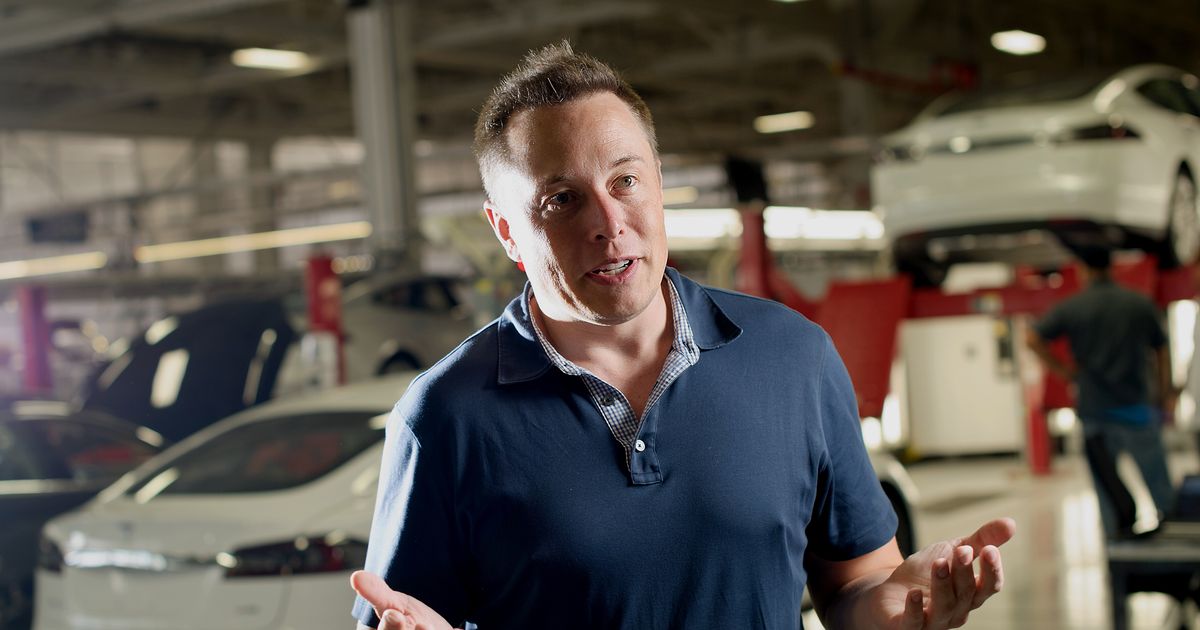
  • Tesla Union Push Continues, Despite Musk’s Promises of FroYo

    Tesla Union Push Continues, Despite Musk’s Promises of FroYo

    And a roller coaster! Come on!
    Photo: Noah Berger/Bloomberg via Getty Images

    Workers at Tesla’s Buffalo Gigafactory are unionizing to demand better compensation and improved workplace conditions, WVIB News reported on Thursday morning. The United Steelworkers and the International Brotherhood of Electrical Workers are leading a joint drive to organize different job descriptions — production and manufacturing — within the factory. “They can improve on demands from the workers that are much needed in the workplace,” said Tesla worker Pete Farrell, going on to cite “fairness, job security, higher wages” as reasons to organize. WVIB plans to release a longer investigation into the Gigafactory’s conditions on Thursday evening.

    Tesla’s Twitter-happy founder and CEO, Elon Musk, has yet to weigh in on the matter, but soon he may have to. Buffalo’s Gigafactory isn’t the only Tesla facility to try to unionize. When workers at his Fremont, California, car plant announced their intention to organize with the United Auto Workers in 2017, BuzzFeed News reported that Musk accused one worker of being a “union plant” in an email to staff, and promised to build “a Tesla electric pod car roller coaster” and free frozen-yogurt machines. This did not dissuade Tesla workers from organizing, in Fremont or elsewhere. In fact, if conditions inside the Buffalo facility resemble those at Tesla’s other factories, the USW/IBEW organizing drive looks inevitable.

    or Wired report, published Thursday morning, depicts a mercurial Musk who regularly berates employees at his Nevada Gigafactory, seemingly with no check on his power. “Sometimes Musk would terminate people; other times he would simply intimidate them. One manager had a name for these outbursts — Elon’s rage firings — and had forbidden subordinates from walking too close to Musk’s desk at the Gigafactory out of concern that a chance encounter, an unexpected question answered incorrectly, might endanger a career,” Wired wrote.

    Several months ago, a lengthy Business Insider report on the Nevada factory described it as a crowded, chaotic place that overworked employees. “People quit within the first two hours, people quit after a week. There was one guy who was fresh out of high school, 18 years old, never had a job before and was excited to work: ‘I want to work seven days a week, 12 hours a day!’ By about the fifth day, he was on the floor crying,” Jonathan Galescu, a welder, told Insider. Galescu is trying to organize a union at Tesla, and he, like his would-be comrades in Buffalo and Fremont, faces stiff opposition from the company’s management.

    Although Tesla has said employees are free to unionize as they choose, workers themselves have repeatedly complained of anti-union coercion and intimidation from management. One former worker, Dezzimond Vaughn, told the The Guardian in September that he believes he was terminated for holding union meetings at his home. The The Guardian verified Vaughn’s record of superlative work performance — and verified, too, that his reviews suddenly took a downward turn after management learned that he’d begun to organize. Other California workers said they were discouraged from wearing union shirts, and that management shut down workplace conversations about organizing. Although Tesla has taken some steps to reduce injuries, a Reveal investigation found in April that Tesla had omitted some workplace injuries from its official reports, which made the company’s factories look safer than they actually were.

    UAW has filed several unfair labor practices charges against Tesla with the National Labor Relations Board. According to Jalopnikone of those complaints stemmed from a meeting Musk held in 2017, during which he reportedly told workers that “it would be futile for them to select a union as their bargaining representative by telling them that employees did not need a union and that (Tesla) would allow them to have a union if (Tesla) failed in its efforts to remedy their safety grievances.” On December 21, representatives for Tesla and the UAW are scheduled to file new briefs in an ongoing NLRB hearing. At times, Musk himself has complicated those very NLRB proceedings; the board filed a complaint in August alleging that Musk violated labor laws when he appeared to tweet that workers would lose their stock options if the UAW organized the company’s Fremont, California, plant. In July, Musk’s girlfriend, the musician Grimes, also inserted her foot directly into her mouth on the subject of unions; on her own Twitter account, she claimed that she had tried to “instigate” a union vote, whatever that means.

    Buffalo workers, then, are wading into an already-fraught battle. Although they aren’t working with the UAW, their organizing drive still increases pressure on Tesla management. And Buffalo is capable of throwing quite the gauntlet. Once a mighty steel town, Buffalo has a strong labor history with USW in particular; the union even once represented workers at the defunct steel plant that the Gigafactory replaced. Complicating matters even further, the Gigafactory was built with $750 million in taxpayer funds as part of Governor Andrew Cuomo’s vaunted Buffalo Billion project. Although Cuomo branded the project as a way to revitalize Buffalo’s economic health, the New York Times reported in July that the Buffalo Billion has achieved “uneven” results for the city and surrounding region. Perhaps for related reasons, eight people connected with the project were either convicted or pleaded guilty to charges of corruption. One, Alain Kaloyeros, is headed to prison for three-and-a-half years, according to the Rochester Democrat and Chronicle. Some local officials had already expressed concern that Tesla wasn’t on track to deliver the employment results the company had promised, something Tesla itself disputes.

    Musk has said that Tesla’s work will change the world. Cuomo wanted to change Buffalo. Buffalo’s Gigafactory workers look ready to call in both promises.

    Update: Tesla responded to this piece with the following statement:

    Tesla greatly values ​​its employees and the direct relationship it has with them at our Buffalo facility. We offer wages and benefits that exceed those of other comparable manufacturing jobs in the region, and we recently increased our base pay even further. In addition, unlike other manufacturers, every single employee is an owner of Tesla, as everyone receives stock upon hire and for good performance, which results in significantly more compensation beyond our already high wages.

    Other factories are shutting down in the US and we still have a long way to go to make Gigafactory 2 financially sustainable. Nevertheless, we continue to do everything we can to keep exceeding our commitments to jobs and business in Buffalo.

    Today’s demonstration consisted almost entirely of groups outside of Tesla, not Tesla employees. And ultimately, it’s up to our employees to decide if they want to be unionized. While we will never please everyone outside of Tesla, we have an unwavering commitment to providing a great workplace for our employees. That’s what matters.

    Source link

  • Justin and Hailey Bieber Partied With Kendall and Kylie

    Justin and Hailey Bieber Partied With Kendall and Kylie

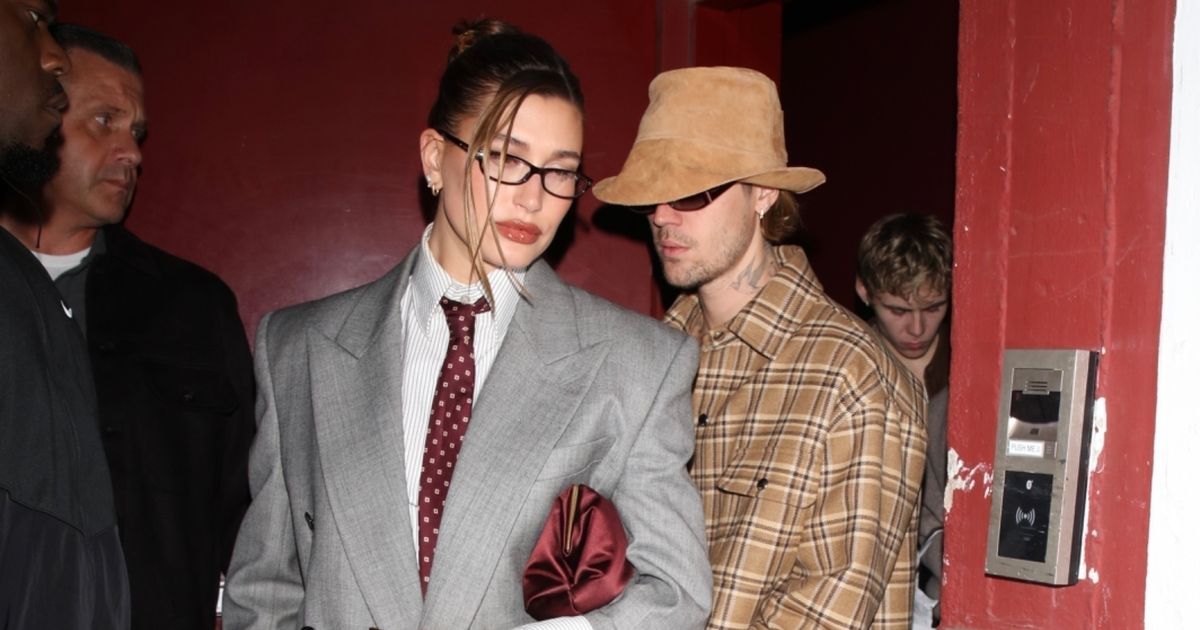
    Hailey and Justin Bieber leave Funke after attending the Rhode Skin launch party in Beverly Hills

    Photo: HEDO, JAVI/STAR INFLUX LA / BACKGRID

    There is apparently nothing like a new food-inspired Rhode product to get people partying. On Wednesday, Justin and Hailey Bieber honored the launch of the brand’s new Barrier Butter with a large group of celebrity friends, marking one of the couple’s first big public appearances since welcoming their baby in August.

    Justin and Hailey arrived at the party, which took place at Funke in Beverly Hills, in their usual distinct style — Hailey in a gray suit that looked oversized enough to have witnessed Black Monday, and Justin sporting equally large pants, a bare chest, and a suede hat. Joining them to take photos with “RHODE”-stamped bread: Kylie and Kendall Jenner in strappy all-black outfits, Lori Harvey, and Tate McRae and her boyfriend, The Kid Laroi. Bella Hadid set aside her desire to stop by, too, rounding out a girl group that hasn’t been seen altogether in quite some time.

    It’s been a quiet few months for Justin and Hailey. While they focus on their new family member, Jack Blues Bieber, some sources have also claimed that Justin is “in a hard place mentally” as he processes Diddy’s looming sex-trafficking trial.

    However, it seems like these two have been able to enjoy some time out on the town this week — they stopped by I wanted Cat’s birthday party a few days before the Rhodes event. Plus, the vibes must have been good on Wednesday night — Justin was seen squeezing Hailey’s butt on the way out of the party. Looks like they had fun!

    Source link

  • ‘Severance’ Season 3 Confirmed By Ben Stiller Himself

    ‘Severance’ Season 3 Confirmed By Ben Stiller Himself

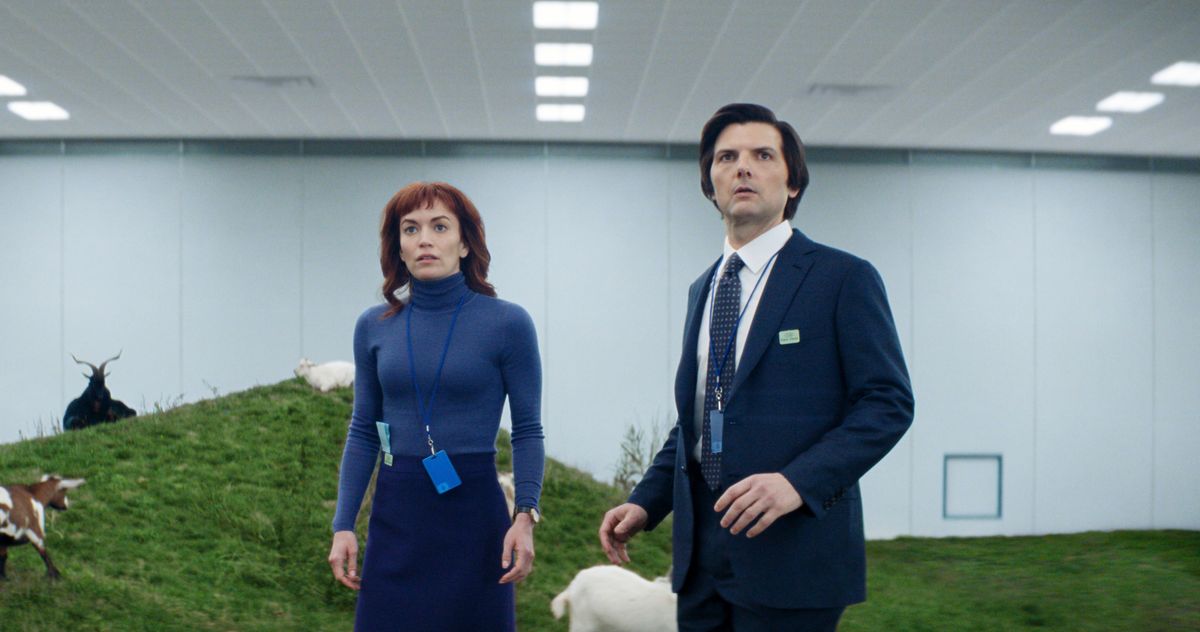
    Britt Lower and Adam Scott.
    Photo: Apple TV+

    Lumon has spoken with the shareholders, and Severance is now officially renewed for season three, as confirmed by Apple’s Tim Cook himself on Twitter. At least Ben Stiller didn’t get sent to the break room. “Making Severance has been one of the most creatively exciting experiences I’ve ever been a part of,” Stiller shared in a press release. “While I have no memory of this, I’m told making season three will be equally enjoyable, though any recollection of these future events will be forever and irrevocably wiped from my memory as well.”

    Thankfully, the gap between seasons will be way shorter than three years, as Stiller promised the plan is “definitely not” to wait that long to find out what happened to Mark S and the Macrodata Refinement department. Stiller confirmed it THR last month that a season-three writers’ room is already back to work.

    Source link

  • Best Movies and TV (Nov. 21–23)

    Best Movies and TV (Nov. 21–23)

    Clockwise from top: Wicked: For Good, A Man on the Inside, Selena y Los Dinosand Train Dreams.
    Photo-Illustration: Vulture; Photos: Netflix, Giles Keyte/Universal Pictures

    I’ve heard it said that film recs come into our lives for a reason, bringing something we must watch… I don’t know if I believe that’s true, but I know you’re here today because you have no clueeeee. Okay, here’s some weekend-watch suggestions so you can put down that remote for good (or, you know, for now).

    The closing chapter to last year’s phenomenon, Wicked: For Good sets to wrap up Elphaba and Glinda’s stories post-Shiz. Elphaba is determined to expose the Wizard while Glinda marvels over her newfound fame and Fiyero sulks. For Good doesn’t have the heavy-hitting songs of the first act, but there are still some songs to look forward to.

    Have somebody special in your life who loves Wicked and/or pink and green? We’ve just got the gift guide.

    Netflix is ​​making sure you’ve got stuff to watch with your parents this Thanksgiving, and they’re going to be particularly tickled to see Ted Danson’s private-investigator character fall in love with his real-life wife, Mary Steenburgen. — Kathryn VanArendonk

    “Please, for the love of God, don’t watch this magnificent movie on your phone.”

    (Streaming on Netflix. Read more of Ebiri’s review TIMES.)

    Brendan Fraser stars as an American expat working as an actor in Japan who gets a gig with a rental-family service, meaning he stars in real people’s lives. Would you believe that playing pretend leads to some real feelings in this sweet crowd-pleaser? —James Grebey

    In the first Sisua rugged old Finnish man revealed he was actually a legendary commando as he brutally obliterated a bunch of Nazis in a Waffen-SS platoon. In the sequel, he’s tearing apart the Soviet Red Army officer who killed his family. What more could you possibly want from the cinema? —JG

    Selena Quintanilla’s legacy is a lasting one bolstered by her sheer talent and charisma and, unfortunately, tragedy. Her story has been told many times, most notably in the Jennifer Lopez-led biopic, but filmmaker Isabel Castro’s documentary gains insight into Selena’s life from old family footage. It’s a really lovely watch for any Selena fan.

    Ken Burns’s new six-part, 12-hour doc, co-directed with Sarah Botstein and David Schmidt, takes his lifelong project of probing America’s soul straight to its roots, arriving at a fraught moment for both the country and PBS itself amid the defunding of public media. It will feature narration from Tom Hanks, Claire Danes, Matthew Rhys, and Josh Brolin, among others. — Nicholas Quah

    Critical Role, the group of nerdy-ass voice actors who have made a living streaming Dungeons & Dragons games, are back on Prime Video with another animated series. The first show, The Legend of Vox Machinaadapted their first D&D campaign while The Mighty Nein tackles the second, which is a bit darker and more complex. No prior knowledge of dice-rolling is required, though — this works as a standalone fantasy adventure. —JG

    The annual wintertime special is the lowest-stakes this show can get, since Paul Hollywood and Prue Leith are on their best judging behavior and the contestants are just there to have a fun yuletide. Even still, the challenges are probably more difficult than anything you’ll bake this year. —Roxana Hadadi

    Benedict Cumberbatch and Olivia Colman star in this remake of the 1989 divorce-comedy classic The War of the Roses nor a couple whose seemingly perfect marriage comes completely undone. Darkly satirical shenanigans ensue as these two crazy kids fail to work it out. —JG

    Bolstered by the undeniable chemistry between Vera Farmiga and Patrick Wilson, the Conjuring films are one of the most successful horror franchises. Last Rites loosely tackles the story of the Smurls, a family haunted by a vengeful demon. It was also marketed as the last film with Farmiga and Wilson as the Warrens, which is such a bummer, especially since there’s no sign of The Conjuring universe slowing down.

    Plus, Luca Guadagnino’s drama After the Hunt is now on Prime Video, while If I Had Legs I’d Kick You is available on VOD.

    Want more? Read our recommendations from the weekend of November 14.

    Source link

  • Jackson Browne Announces Death of his Son, Ethan

    Jackson Browne Announces Death of his Son, Ethan

    Fatburger Grand Opening in Brentwood California

    Photo: Ray Mickshaw/WireImage

    Singer-songwriter Jackson Browne announced the death of his son, model and actor Ethan Browne, on his official Facebook page Wednesday night. “It is with deep sorrow that we share that on the morning of November 25, 2025, Ethan Browne, the son of Jackson Browne and Phyllis Major, was found unresponsive in his home and has passed away,” the statement read. “We ask for privacy and respect for the family during this difficult time. No further details are available at this moment.”

    Ethan Browne was born to Jackson Browne and model Phyllis Major in 1973. Six months later, he was on the cover of Rolling Stone in his father’s arms. “I wanted a baby ’cause I wanted to be a baby,” he said in the cover story. “I play with (Ethan) all the time; there’s something pure about it. Look at all those expressions he’s got. He’s a real kick in the ass.” Jackson Browne and Major married in December 1975, and Major died by suicide four months later in 1976. “I only had two things that I hoped I could fit together,” he said in 2021“being a songwriter and a father.”

    Ethan worked as a model, actor, and musician. He played a role in 1995 Hackers starring Angelina Jolie and Jonny Lee Miller, as well as the 2004 Kate Hudson film Raising Helen. He later pivoted to music, starting a record label and releasing an album with Cat Colbert, the child of bassist Charles Colbert.

    Jackson Browne’s statement gave no cause of death. Ethan Browne is survived by his father and his half-brother, Ryan, who is the child of Jackson Browne and his second wife Lynne Sweeney.

    Source link

  • Taylor Swift’s Onetime Sublet at 23 Cornelia Asks $17.9M

    Taylor Swift’s Onetime Sublet at 23 Cornelia Asks $17.9M


    Photo: Al Siedman/VHT for The Corcoran Group/)2022 VHT Studios All rights reserved

    Swifties will apparently pay anything for tickets to the Eras tour, but what about the West Village carriage house where Taylor Swift spent a few months in 2016? The 5,500-square-foot home at 23 Cornelia Street — where Swift lived briefly but, at least according to her lyrics, vividly, while her $50 million Tribeca loft was undergoing renovations — is now on the market for $17.995 million with Corcoran’s Laurence Carty. Whether or not it will sell at that price is a matter of debate among brokers.

    The carriage house last sold in 2019 for $11.5 million, according to city records. It’s been renovated in the years since Swift rented it and has five bedrooms, four full baths, two half-baths, and a number of terraces with gas fireplaces. There’s also an indoor lap pool and a garage — unusual features that some brokers say could win over a deep-pocketed buyer. “I am the biggest fan of unique properties,” says Sydney Blumstein, a Corcoran associate broker who grew up in Greenwich Village and has sold a lot of real estate there. “You can’t compare a private swimming pool on a quiet street like Cornelia.” For David Kornmeier, an associate broker at Brown Harris Stevens, the garage is the real draw for a certain tier of high-profile buyers who don’t like being photographed getting in and out of their cars: “Some people like having a pool and some don’t, but everyone likes a garage.”

    Photo: Al Siedman/VHT for The Corcoran Group/)2022 VHT Studios All rights reserved

    But other brokers I spoke with pointed out that you could get a lot more square feet in the neighborhood for $18 million. And some properties with similar amenities have languished on the market for considerably less: For example, 196 West Houstona 7,200-square-feet home with a two-car garage that’s asking $12.95 million, has been on the market for 266 days. Or 33 Perry Streetwhich is now in contract, last asking $16.9 million for 8,668 square feet. “You can buy something much bigger for that,” says one broker. “And I know Cornelia is dreamy, but there are also a ton of restaurants on that block. It’s kind of busy.”

    Photo: Al Siedman/VHT for The Corcoran Group/)2022 VHT Studios All rights reserved

    Which also brings us back to the Swift connection. “It’s kind of tangential,” as one broker put it — likely not enough to motivate a buyer. But the singer’s brief tenure at the address has turned it into a destination for fans after all breakup with Joe Alwyn earlier this spring (for the non-stans, the song “Cornelia Street” waxes nostalgic about the early days of their romance), which may be a deal breaker for the kind of buyer who would pay nearly $18 million for a property with a private garage entrance. Walking out your door to the occasional horde of Swifties or sweeping up the bodega roses they leave behind may not appeal.


    Source link