الكاتب: admin

  • DePaul Prep opens season at No. 1 as Rams’ quest for four-peat heads to Class 4A

    DePaul Prep opens season at No. 1 as Rams’ quest for four-peat heads to Class 4A

    DePaul Prep guard Rykan Woo is a thoughtful kid who spends a few seconds ruminating before he answers a question. But the Brown recruit didn’t pause at all when asked what fans should expect this season from teammate Rashaun Porter.

    The two seniors are key players for the Rams, the top-ranked team in the Sun-Times’ preseason Super 25 rankings.

    “The only word to describe it is ‘dominant,’” Woo said. “He’s going to dominate. He’s a great player and a great person. The best thing about him is he’s really smart. He does the right things to win. That’s going to be showcased this year.”

    Porter, a 6-7 Toledo recruit, played with an enticing blend of skill and physicality last season while leading DePaul to the Pontiac Holiday Tournament title and the Class 3A state championship.

    “(At Pontiac), I started to figure out my role,” he said. “It was a new style we were playing and a huge change. I had to understand that and step up more.”

    Porter, who was born on the West Side and moved to Hillside in third grade, slimmed down and worked on his guard skills over the summer.

    “He’s our catalyst,” DePaul coach Tom Kleinschmidt said. “We go how he goes. When he’s vocal in practice, it raises our whole team.”

    Kids who stand 6-7 are occasionally pushed into playing basketball, but that’s not the case with Porter.

    “Basketball has always been important to me,” he said. “It’s always been the way for me to clear my mind and find success. I value it and work hard in it. And that’s what I found in DePaul — a place where I could do that and ultimately be myself.”

    Porter’s first visit to the school to see a high school game several years ago is a core memory.

    “There was so much energy,” he said. “It was (St. Ignatius) vs. DePaul on grade school night. Everyone was screaming and yelling. It was hard for me to hear the person right next to me. I could imagine myself on the court, going up for a dunk in the middle of all that.”

    Although Woo and Porter are the headliners, DePaul has a tall, talented team surrounding them.

    “I like to play four guards and a big, so it will be an adjustment,” Kleinschmidt said. “This is the biggest team we’ve had. We will go 6-8 and 6-5, so that is pretty long.”

    Senior guard AJ Chambers, a Michigan Tech recruit, is another Rams player who made significant strides over the summer.

    “He’s a playmaker, a powerful point guard that gets guys the ball,” Kleinschmidt said. “His footwork is unbelievable. He plays his gaps on defense and gets big steals.”

    Sophomore guard Blake Choice, senior guard Pat Lovell and 6-8 junior forward Gus Johnson will have bigger roles. The Rams also picked up a major addition in Zion Lee, a 6-5 senior guard who transferred from Sacred Heart-Griffin.

    “(Lee) is a freak athlete,” Woo said. “He’s huge, really strong and really physical. He sets great screens, and he’s a great scorer. My favorite part of his game is his mid-range. It’s tough to stop that when he’s 6-5.”

    Woo, a fan favorite for a few years, plays with an understated flair when things are flowing. He started and ended last season well but spent a stretch adjusting to being a marked man.

    “There were highs and lows,” Woo said. “Teams didn’t know me at the start, but as the season went on, I was struggling with being face-guarded and teams centering the defense around me.”

    After winning the Class 2A state title in 2023 and the Class 3A title in 2024 and 2025, the Rams have moved up to Class 4A this season and are attempting a four-peat. Last season, they won their seven Class 3A playoff games by an average of 28 points.

    “The playoffs (this season) are going to be vastly different,” Kleinschmidt said. “We understand that.”

    Their challenging schedule includes a meeting with Indiana’s La Lumiere — the prep school that former Kenwood star Devin Cleveland transferred to — at the Chicago Elite Classic on Dec. 6.

    Source link

  • ‘Severance’ Finale Recap, S2, Ep. 10: Honeymoon Ending

    ‘Severance’ Finale Recap, S2, Ep. 10: Honeymoon Ending

    Severance

    Cold Harbor

    Season 2

    Episode 10

    Editor’s Rating

    5 stars

    Photo: Apple TV+

    For more on Severance, sign up for Severance Club, our subscriber-exclusive newsletter obsessing, dissecting, and debating everything about season two.

    Murder! Jailbreaks! Marching bands! Goats! Yet again, the Severance finale delivers a wondrous Innie rebellion, but this time, the call was coming from inside the house. Written by series creator Dan Erickson and directed by Ben Stiller, “Cold Harbor” is a captivating hour-plus of television that serves up several palpable gut punches, some cryptic Lumon lore, and a handful of the most visually stunning sequences the show has ever put onscreen. Seriously, if they offered a screening of this episode in a movie-theater format, I’d go see it. Twice.

    While the finale is admittedly light on overt answers to the myriad Lumon mysteries — a potential frustration for many theory-focused viewers — it presents us with something profound and lasting. Severance runs on emotion the way that Ben Affleck runs on Dunkin’, and the nebulous nature of the answers we do get are in service of a larger goal: to encourage us to feel and think, deeply and with abandon, about the wild experience of being human. The show is truly wonderful as a platform for theorizing about sci-fi twists, but season two has proved that, more often than not, the simplest answer happens to be the correct one. (See “The Curious Case of Miss Huang.”) Or, in the case of the lingering mysteries, Severance seems to be suggesting that coming to the “correct” answer is like a litmus test — the space between knowing and not knowing, giving each viewer the space to choose an answer that speaks most strongly to their experience.

    The finale focuses on Mark and his season-long journey to free Gemma from Lumon, with each scene building exponentially on the previous one until it ends in a glorious crescendo of violence, reunions, and forbidden love. In the opening moments, we’re snapped back into the thick of it as Ms. Cobel and Devon accost Innie Mark. Cobel begins to inform him about the black hallway, and she is absolutely gobsmacked to find out that he already knows about it. Honestly, Felicia knew about it, so it wasn’t that big of a secret, but the idea that Irving was able to get that information into Lumon speaks to how savvy he is. We don’t see Irving at all in this episode, but we’re reminded that Gemma’s ultimate escape could not have happened without him. John Turturro must come back for season three, if only for a proper Innie reunion between our core MDR crew. (Could that even happen? I’m holding out hope!)

    Innie and Outie Mark get a chance to chat with each other via camcorder, and Adam Scott does some excellent work here. He manages to make Mark’s innie and his outie into two very distinct people, even as we’re volleying between the two. Outie Mark starts off contrite but eventually ends up sounding like a used-car salesman when he tries to pitch the idea of reintegration as a little treat. Innie Mark gets increasingly agitated as he realizes that he really has no reason to trust his other self, and he really freaks out when his outie gets Helly’s name wrong. I’ve previously mentioned in these recaps that Dan Erickson has noted that season two sees the innies enter into adolescence, and there’s a distinctive layer of the back-and-forth between Innie and Outie Mark that plays like a chat between a father and his newly rebellious son. Innie Mark doesn’t want his life controlled (or ended). He wants his own love and the ability to make his own choices. The remainder of the episode leans on the idea of defiant adolescence, utilizing high-school motifs like giving a walkie-talkie a swirlie, showcasing a whole-ass marching band, and running through seemingly endless hallways.

    When Innie Mark eventually takes a stand against Outie Mark, Cobel comes to see him and finally gives him some useful information. She shares that every file he has refined has been a separate consciousness for his wife, Gemma. (Let’s all note that Cobel refers to Gemma as Innie Mark’s wife, too.) He’s good at it because his intimate knowledge of her passes the severance barrier. He’s been balancing her tempers in 24 (!) different configurations, creating a different innie for her every time. We know this already, but Patricia Arquette’s matter-of-fact delivery is chilling nonetheless.

    Innie Mark demands that Lumon be the next thing he sees, and Cobel and Devon don’t disappoint. In an electrifying whoosh, Mark S. steps out of the birthing cabin and off the elevator. A terrifying new painting accosts his eyeballs. I have looked at this painting many times, and while there are a lot of insanely disturbing things going on here, I’m most freaked out by the fact that Mark’s eyes are closed. Why? Ew.

    Helly arrives, and she and Mark are directed to MDR, where an animatronic statue of Kier awaits. (A remnant from Branch 5X, no doubt.) He’s holding a pop-up waffle card with a note from Milchick. Mark is to finish the file; Helly is to watch. (A curious inverse of her father watching her Outie eat that egg last week.) They catch each other up on their completely insane evenings. Helly tells Mark about her creeptastic encounter with Jame Eagan, saying that he sees the “fire of Kier” in her. Do we think that Jame possibly wants to crown Helly as the next in line at Lumon? Could my wildest dreams of Helly’s innie becoming her permanent state be coming true?!

    There’s no time to think about that because Mark then shares what he knows. Helly, for her part, thinks that he should trust his outie, Cobel, and Devon. She advocates for him to reintegrate so he has a chance at living, but Mark tearfully responds that he doesn’t want to live without her. It’s a wrenching beat, made even more tragic because Mark spies the last number blob at the same moment. Helly scoots over to him, her body protectively spooning him. Lit by the eerie dimness of the office space and the glow of the computer screen, the two innies meld into one entity, determined to see their plan through. “At least it’s a happy one,” Helly says as Mark banks the final cluster.

    As soon as Mark completes the file, all hell breaks loose. Milchick comes out and does a wackadoo comedy routine with the Kier Eagan statue. It’s unclear who’s providing the voice for Kier, but whoever it is also has an issue with Milchick’s stellar vocabulary. They snipe at one another for a minute, with Kier pointedly calling Milchick by his first name, Seth. And then, a new severed department is revealed. The Choreography and Merriment team come marching down the hall, horns ablaze, to celebrate Mark’s victory. All of this cacophony and chaos feels like some sort of vision Dan Erickson may have had after eating one too many weed gummies, but it’s disorienting in a fun way, and it pays off in a fantastic visual.

    Dylan’s return coincides with the completion of Cold Harbor. His outie has declined his resignation. Like Outie Mark’s first missive to his innie on the camcorder, the response is kind and mostly understanding. Outie Dylan is upset that his innie made out with Gretchen but, ultimately, he gets it. They do share physiology, after all, and because Outie Dylan had never really been super-impressive, he likes knowing that Innie Dylan is there in all his badassery. This message motivates Innie Dylan to participate in the mêlée that ensues in MDR without even asking what’s going on. As soon as he sees Helly trying to barricade Milchick in the bathroom, he single-handedly rolls the vending machine into the doorframe. Whoa. Maybe his outie really should do muscle shows.

    Helly and Dylan stave off Milchick while Mark races to the black hallway. Alas, he doesn’t have a working key card when he gets there. But Lorne and Drummond are in a secret room just beyond the mystery door. They’re dealing with a goat, and Lorne is visibly upset.

    Okay. Let’s talk about the goat for a minute, because there seems to be a concrete answer here. Given what we see in the finale, I don’t think they were putting chips in the goats or cloning them. The goats simply appear to be sacrifices, their spirits meant to guide the souls of each completed test subject to meet Kier in heaven after the severance chip is removed from their brain and they die. (The removal fact is revealed in a throwaway line by Helly in the MDR scene with Mark.) However, this concept does raise more questions. If there have been many other sacrificial goats — there’s an entire room and specialty equipment devoted to killing them, after all — there have clearly been many other test subjects who have completed their purpose. So why is Gemma so special? Also, what are they doing with the severance chips once they’re removed from a test subject’s brain?

    Lorne, absolutely rocking a black mourning shroud and red-eye makeup, clearly does not want to sacrifice this adorable goat. It’s a relief when Mark’s loud banging shifts Drummond’s attention elsewhere. When he spots Mark, he slams him up against a wall and sucker punches him in the face. And thus begins the most wildly violent sequence in Severance history. Mark is no match for Drummond, but Brienne, er, Lorne is. Her rage over her lost baby goats fuels her, and she joins the fray, handily taking down this giant evil man and pointing the bolt gun at his head. Mark steps in from there, guiding Drummond down the hall and into the elevator at gunpoint. In a tremendous moment, Innie Mark turns into Outie Mark, and the transition triggers a muscle reflex that discharges the gun right into Drummond’s jugular. This is what Outie Mark wakes up to. This accidental murder is hilarious, gory, and victorious all at once. I laughed. I gasped. I had myself a time.

    Then, Outie Mark gets a John Wick moment. His suit covered in blood, he carefully makes his way down the hall. In another humorous beat, he bumps into Gemma’s nurse, and the two shriek futilely at each other while Mark uselessly waves the empty gun in her direction. She goes to find help, giving him enough time to find the Cold Harbor door, using Drummond’s blood on his tie as the key. Inside, Gemma is dressed in the clothing from the day she “died,” and she’s been instructed to disassemble the baby crib that she and Mark once owned. Dr. Mauer and Jame Eagan look on from separate monitors (Jame really likes to watch), and Mauer marvels at how the severance barrier is holding. “She feels nothing,” he says.

    This tableau gives us more insight into what Lumon is looking to do with the chips. The crib, representing Gemma’s deepest trauma, is the clear watermark for the severance chip to overcome. But, as Outie Mark notes to his Innie in the opening scene, we’re a collection of our traumas and memories, and to sift out the bad is to mute the good. Innie Mark also makes this point, saying that even though they basically live in hell, they’ve found ways to be happy and fulfilled. Lumon is certainly seeking to create a product that many people might want — the ability to sever from all discomfort or pain — but our traumas are ultimately a part of what make us us. The process of working through them is often painful, but completely severing from any personal experience, both the bad and the good, prevents us from wholly being ourselves.

    After four long years, Mark Scout finally sees his wife, and I swear my heart skipped a beat. He reaches out to her, telling her that he’s her husband and reassuring her that it’s okay. She chooses to trust the blood-soaked man in front of her instead of the disembodied voice in the ceiling (what a choice!) and takes Mark’s hand. Yet again, I must emphasize that the body keeps the score in Severance because both Dr. Mauer and Jame Eagan freak out when Gemma and Mark make a physical connection, indicating that a meaningful human touch can revert the excruciating progress made by four years of torturous experiments.

    As Gemma and Mark flee, a red light begins to strobe the hallways, bathing the sterile white walls in red. The evil doctor is in hot pursuit. As they go up the elevator, the last thing we hear him say is “You’ll kill them all!” What could this mean? Is he talking about all the innies, ever? Or are there other test subjects secreted away on the testing floor? If so, who were Dylan, Petey, Helly, and Irving refining? And why do most of the files expire? Because people can’t take the addition of more than a few innies before their brains break? There’s so much to consider.

    Once in the elevator, Gemma and Mark make out like there’s no tomorrow, but they soon revert to their innie selves. Ms. Casey extracts herself from Innie Mark’s embrace, asking, “What’s taking place?” This line gave me a genuine chuckle. This episode is funny, y’all! But once the two reach the door to the stairwell, Innie Mark pauses. He scoots Ms. Casey out, and she becomes Gemma. But Mark does not follow. Instead, Helly appears on the other end of the hallway, and he makes his choice. As he walks away from the stairwell, Gemma screams in anguish, beseeching Mark to come back to her, but she’s not the one Innie Mark loves.

    Mark runs to Helly, grasping her hand and running further into the unknown depths of the severed floor. Set to the tune of Mel Torme’s “The Windmills of Your Mind,” the two giddily smile, but then their faces settle into more neutral expressions as they contemplate what happens next. It’s very Graduate coded, as these two nascent innies don’t have a plan beyond the rush of being together … but they get to make the decisions. For now.

    When Severance first premiered, I talked about the 87-second walk that Mark takes through the hallways of Lumon, stating, “In a pop-culture landscape that has primed us to expect often fast-paced, Sorkin-esque walk-and-talks to provide exposition for our protagonists wherever they go, this interlude is inviting our collective brains to take a beat.” Since that time, Severance has consistently utilized the sprawling hallways of Lumon to great effect, most notably in the season-two premiere and now here in the finale as Helly joins Mark in his hallway jog, red warning lights bathing their faces as they run to an indeterminate location. That season two concludes with a scene featuring the Lumon labyrinth confirms my theory that the hallway moments serve to define the series. These scenes test our ability to buy into the emotional crux of the narrative, asking us to be patient, curious, and willing to go on a journey that might not always traffic in concrete answers but will never fail to make us feel something real.

    I’ve truly enjoyed being your Lumon luminary throughout this season of Severance, and I hope you appreciated all of these recaps equally and without preference.

    • Do we think Helly will somehow use her Kier-fire leverage to accrue real power in the Lumon hierarchy? Will season three see her as the leader of a true Innie revolution? If so, sign me up for all of it.

    • The red credits at the end are a nice touch, indicating that the severed floor has been forever touched by the outside world.

    • The pregnant Kier in the birthing cabin is so fucking creepy. I can’t.

    • I’m still a little confused on the mystery of the man lingering behind Mark S. when he ran down the hallway in the premiere. Is Jame Eagan just always creeping around the floors below Lumon? Otherwise, I don’t have a good answer for this one.

    See All

    Source link

  • Every ‘Wicked’ and ‘Wicked: For Good’ Song, Ranked

    Every ‘Wicked’ and ‘Wicked: For Good’ Song, Ranked


    Photo-Illustration: Vulture; Photos: Giles Keyte/Universal Pictures

    Take it from Fiyero: “Life is fraught-less when you’re thoughtless.” While the Wizard of Oz prequel tells a reasonably compelling story — albeit a much safer one than the Gregory Maguire novel the show is based on — Wicked fans are here to dance through the songs. There are 11 in the first act of the hit Broadway musical, so that’s exactly how many there are in Wicked. Wicked: For Good beefs up the stage show’s second-act song count with new numbers created just for the film.

    All the familiar songs are there, from showstoppers like “Defying Gravity” and “No Good Deed” to songs you’d traditionally skip on the album like “Something Bad” and “A Sentimental Man.” As in his 2021 stage-to-screen adaptation of In the Heights, director Jon M. Chu shows real skill in putting together big production numbers, but he also has some tricks up his sleeve. Some of the Wicked movies’ best musical moments happen when Chu finds a new cinematic language to filter them through. At the same time, it’s easy for certain songs to get lost amid the scope and grandeur of a $300 million production.

    It’s not exactly controversial to say there are highs and lows to Stephen Schwartz’s Wicked score. Identifying the best and worst musical numbers in the movies may seem obvious to anyone who knows the show. But to put together this ranking, I tried to look at the big picture, including the performances, the staging, the visuals, and, perhaps most important, how many times the song made me think, Okay, they ate that.

    Look, Jeff Goldblum was not hired for his singing voice, which is basically fine. “A Sentimental Man” is barely a full number and is most notable for one of my favorite “You’re not gonna get away with this, Stephen Schwartz!” rhymes: “And helping you with your ascent allows me to feel so parental” (you have to sing “ascental” to make it work).

    In the film, we do get the Wizard dancing around his neat little Oz model, and that’s fun. My biggest issue with “A Sentimental Man” is that Goldblum is too much of a character in his own right to ever let you fully believe him as the Wizard. In a song that calls for sincerity — or at least the performance of sincerity — his inherent Jeff Goldblum–ness becomes more glaring.

    What can I say? Aside from giving Galinda a chance to show off her high notes — and you can never have too many of those moments, whether from Ariana Grande, Kristen Chenoweth, or any of the other soprano divas who’ve played the Good Witch over the years — there’s not a lot here. Even the introduction of Keala Settle’s Miss Coddle can’t do much to make “Dear Old Shiz” stand out. (No fault of Settle’s; it’s just not a “This Is Me” moment.) At the same time, everyone sounds great. Whether through the magic of live singing or the magic of postproduction, their voices meld beautifully.

    There’s really no other place to rank “Dear Old Shiz” than near the bottom of the list, though the biggest mark against it isn’t the song so much as the way Elphaba’s arrival pulls focus.

    The news that Schwartz would write two new songs for Wicked: For Good was greeted with cheers by Wicked fans, along with some healthy skepticism from those less enthused about the composer’s recent output. Unfortunately, “The Girl in the Bubble” is not likely to convince any naysayers. Grande sings it beautifully — that goes without saying, doesn’t it? — but she’s saddled with clunky lyrics like “The girl in the bubble, the pink shiny bubble, it’s time for her bubble to pop.” It’s enough to make you wince!

    And look, not every lyric in Wicked the stage musical is top-tier; I will continue to side-eye wonky lines from much better songs throughout this list. The other problem with “The Girl in the Bubble” is that it’s completely superfluous — aside from qualifying as a potential Oscar nominee for Best Original Song, what does the new number do that hasn’t already been accomplished by “I’m Not That Girl (Reprise)”? Glinda’s bubble has burst! Worse, it brings the momentum from “No Good Deed” and “March of the Witch Hunters” screeching to a halt.

    Perhaps the most infamous skip on the Original Broadway Cast Recording, “Something Bad” is better than expected in the Wicked movie. This is Doctor Dillamond’s big moment, and as many quibbles as I have with the CGI throughout both films — more on this shortly — I’ll concede they did a pretty good job transforming Peter Dinklage into the Goat. (He certainly looks better than Elphaba’s Bear nanny.) And Dinklage’s singing voice is pleasant if not exceptional. He’s at least up to the task of this number.

    As for the scene itself, the Wicked movies do a lot of showing rather than telling, for better and for worse. In this case, the shadow-puppet depiction of the persecution of Animals in Oz is quite effective and distracts from some of the less impressive CGI creations in Dillamond’s salon. This is almost certainly the best “Something Bad” we were going to get.

    Let’s start with the positive: It’s always nice to hear Ethan Slater sing. And while his performance in Wicked was mostly restricted to plaintive yearning for Galinda, Wicked: For Good frees him to show more range as the (spoiler alert) Tin Man. There’s excitement in watching him be riled up in his campaign against Elphaba, and the song has a strong, propulsive beat that flows nicely from “No Good Deed.”

    On the whole, though, there’s nothing particularly interesting or memorable about “March of the Witch Hunters,” which requires Slater to get through a jumbled mouthful of lyrics. The Cowardly Lion’s nonsensical hatred toward Elphaba is explained in the especially tortured line “If she’d let him fight his own battles when he was young, he wouldn’t be a coward today!”

    Wicked: For Good expands the musical’s Act Two opener in ways that give a sense of scope that you can’t achieve onstage. Showcasing Elphaba’s forest lair is a smart move, and the interpolation of motifs from “The Wizard and I” and “What Is This Feeling?” remind us of our own warm feelings toward the first movie ahead of a (sorry to say) significantly less successful sequel. Is it ideal that the first singing voice we hear is Michelle Yeoh’s? No. But as soon as Grande and Cynthia Erivo start singing, all is forgiven.

    For the most part, at least. Like so many of the additions to both Wicked movies, “Every Day More Wicked” doesn’t feel particularly necessary. The new ending, which features the Ozians chanting “for good” is painfully on the nose — we already know what movie we’re watching! In its expanded form, it’s not a bad song, but it’s really just a prelude to “Thank Goodness/I Couldn’t Be Happier,” which has all the “Here’s what you missed between movies” exposition we need.

    Photo: Giles Keyte/Universal Pictures

    The other brand-new song written for Wicked: For Good, “No Place Like Home,” does at least add something to the story, expanding on the Animals’ exile from Oz and Elphaba’s resistance efforts. Because the stage musical is so focused on the relationship between Elphaba and Glinda, we get very little of this — did you know there was an Underground Railroad analogue under the Yellow Brick Road? I certainly didn’t! “No Place Like Home,” borrowing its title from one of countless indelible Wizard of Oz lines, is Elphaba’s plea to the Animals to stand up and fight back instead of giving up and fleeing.

    However noble its intentions — and however stunning Erivo’s voice — the song is simply not very good. It’s admirable that Wicked: For Good overtly links the Wizard’s persecution of scapegoated Animals in Oz to the treatment of marginalized communities in the U.S., with Elphaba singing, “Why do I love this place that’s never seemed to love me?” Beyond the obvious allusions, though, “No Place Like Home” has nothing to say. It’s all banal platitudes, a sort of Ozian fight song. Surely, we could have done better than “If we just keep fighting for it, we will win back and restore it.”

    Photo: Giles Keyte/Universal Pictures

    Goldblum doesn’t sound bad singing “Wonderful,” his big Wicked: For Good number, though you may be too distracted by the incessant prop work to even notice. One of Chu’s adaptation strategies is a perpetual busyness that works better in some moments than in others. It’s pretty neutral here — Goldblum leans into the shtick, and because that’s what we expect at this point, it’s inoffensive.

    The cheat of the movie version of “Wonderful,” which has always been a Wizard song with an Elphaba assist, is that it quickly turns into a Wizard-Glinda duet. If that’s not shameless enough, we even get a brief “Defying Gravity” reprise as Glinda once again tries to get Elphaba to work in tandem with her and the Wizard. Ultimately, I’m an easy mark, which means I will absolutely let the movie win me over with a few bars of a better song than “Wonderful” and a dance under rainbow lights. The song still isn’t making it anywhere near the top of my ranking, though.

    Otherwise known as the song left off the Original Broadway Cast Recording for being too spoiler-y, “The Wicked Witch of the East” has always been a little ridiculous for the speed with which it forces Nessa to break bad. Look, when you need to shoehorn in the entirety of The Wizard of Oz, it’s only natural you might have to cut some corners, and to the movie’s credit, Wicked: For Good does attempt to flesh out Nessa a bit. (Boq tries to leave Munchkinland, and she speedily aligns with the fascists in power out of spite. Sure.) The movie also solves the show’s problem of Elphaba giving her wheelchair-user sister the power to walk by having Elphaba give her sister the power to float instead, which feels less ableist.

    The major problem with the sequence — aside from the issues outlined above, all inherent to the source material — is that it undercuts Nessa’s big moment by focusing on Boq’s transformation. Her big declaration that she has become her sister’s equal, the Wicked Witch of the East, gets drowned out by the Tin Man’s groaning and clanking. It’s a frustrating decision that feels unfair to a character who is already underserved by this story.

    Given the undeniable appeal of Erivo and Jonathan Bailey, “As Long As You’re Mine” might have been the most anticipated musical moment of Wicked: For Good — next to the title song, that is. So what went wrong here? Perhaps it’s the constraints of the PG rating, but there’s a bizarre lack of passion to a song in which Elphaba and Fiyero finally declare their feelings for each other and consummate their relationship. Onstage, they sing into each other’s eyes. In the film, Elphaba starts off singing while standing solo outside her forest lair. Who is she even talking to when she begs, “Kiss me too fiercely, hold me too tight”?

    This is a movie for children, so it’s hard to fault the scene for not being sexier, but does Elphaba really need to undress only to put on a tasteful cardigan? (Fiyero at least gets to show a little chest hair.) That “As Long As You’re Mine” works at all is a testament to the song itself and the compelling screen presence of its performers. While the chemistry between them may fall flat, they each command attention on their own.

    Despite containing another of my favorite “You’re not gonna get away with this, Stephen Schwartz!” lines (“She who’s winsome, she wins him”), “I’m Not That Girl” is not that girl in the Wicked movie. It’s well sung, obviously, and Erivo fares best in scenes where Elphaba is lovelorn and teary-eyed. But there’s an odd flatness to the number, and here’s where I blame the CGI fuzziness that makes the whole forest look artificial.

    The song itself does a lot of the heavy lifting, so it’s hard to complain too much. You just wish Chu had found a way to really lean into the intimacy of the number instead of trying to create a visual moment Erivo gets lost in.

    The pleasant surprise of the first Wicked is that it works more often than it doesn’t. With that in mind, we’ve reached the halfway point of this list, so now we’re dealing with numbers I am largely positive about! “No One Mourns the Wicked” is an encouraging opening for the film, emphasizing Chu’s ability to pull off big production numbers and the care put into creating impressive practical sets. Munchkinland looks great, borrowing just enough from the 1939 Wizard of Oz while feeling like its own thing.

    My one complaint — aside from the aforementioned CGI Bear nanny in the flashback to Elphaba’s birth, a waste of the great Sharon D. Clarke — is that Grande gets a little swallowed up by all the noise around her. This is where the scope of the film, as opposed to the Broadway production, comes into play. Grande’s is hands down the best performance in both movies, but the opening song has so much going on around her that she doesn’t stand out as much as she should.

    As with “No One Mourns the Wicked,” the thrill of “One Short Day” is in seeing how successfully the film pulls off these locations. The Emerald City looks fantastic and contained — the latter may seem like damning with faint praise, but given how overwhelming Wicked can be, it’s nice to have some restraint here.

    While the song itself has never been a personal fave, Erivo and Grande sound incredible together (this will become a recurring theme), and we get an expanded Wizomania featuring original Broadway stars Idina Menzel and Kristin Chenoweth. It’s good to see them, isn’t it? Yeah, we probably don’t need the added exposition, and the way they immediately fall into the Elphaba and Glinda roles is ultimately distracting, but the key to Wicked is not taking it too seriously, and this fits that approach well.

    “Stephen Schwartz, you’re not gonna get away with this!” alert: “There are bridges you cross you didn’t know you crossed until you’ve crossed.” The line shouldn’t work, but somehow it does, and much of the credit for its success in Wicked: For Good goes to Grande, who gives an impressively layered performance in the first Wicked but gets to be even more nuanced in the sequel. She nails the “I Couldn’t Be Happier” section of the song, which requires Glinda to put on a brave face for the assembled Ozians while cluing in the audience to her inner turmoil.

    The rest of the number is sort of just a retread of “No One Mourns the Wicked” with the addition of some new Elphaba-centric conspiracies. What makes “Thank Goodness/I Couldn’t Be Happier” rank as high as it does is Grande’s portrayal of a woman trying to hold it all together from her new position at the top while reckoning with the sacrifices she made to get there.

    If this were a ranking of the best songs in Wicked the musical, “The Wizard and I” would be close to No. 1. It’s still a banger in the movie, naturally, again performed well by Erivo. She even manages to do the “No father is not proud of you” line without making it sound awkward, a constant struggle for Elphabas who aren’t Lindsay Mendez. Even though Yeoh can’t really sing her brief part at the beginning of the song, you quickly forget about that when Elphaba is wandering through the practical Shiz sets.

    When she runs out to the cliffside, things get a little shakier, and the artificiality of the CGI backgrounds and confusing lighting takes over. There’s also the overly literal depiction of Elphaba having “a vision almost like a prophecy” — we actually don’t need that! We just saw “No One Mourns the Wicked” and can probably put two and two together on our own. Erivo’s performance remains solid throughout, though she’s better at the longing than the musical comedy.

    “Eleka nahmen nahmen, ah tum ah tum, eleka nahmen”: I don’t know what the fuck she’s saying, but girl, I am living. The pacing of Wicked: For Good feels draggier than Wicked’s, so it’s a thrill when we arrive at the electric 11 o’clock number. (Really more of a 10:30 p.m. number here, given how stretched out the ending is.) “No Good Deed” feels like the song Erivo has been waiting for, and she crushes it. Obviously, the entire movie couldn’t operate on this wavelength — we have to build to something, after all — but it’s the first real goosebumps moment since the end of the prior film.

    “No Good Deed” could easily rank higher on this list if it weren’t slightly weighed down by Chu’s most frustrating excesses. There is once again an unnecessary literalism to the scene with repeated flashes to what Fiyero is experiencing instead of just letting us focus on Elphaba. And once the camera pulls back to show her surrounded by flying monkeys, the muddy CGI screensaver vibes are inescapable. Toward the end, Elphaba is so backlit, you have to squint to see her. Thankfully, Erivo’s “Fiyero!” option up is the best distraction possible.

    We can acknowledge that when Grande is nominated — or perhaps even wins! — an Oscar for Best Supporting Actress, that’s category fraud, right? While Glinda is (sort of) a supporting character in Wicked, she is fully the co-lead of Wicked: For Good, her arc so central to the story that even her very brief reprise of “I’m Not That Girl” becomes one of the film’s most essential moments.

    After the ostentatious set piece of Glinda’s thwarted wedding and the Animal stampede, it’s a relief to get a quieter moment, and Chu mercifully keeps the focus entirely on Glinda here. Grande sings this song beautifully because of course she does, but she also lets her voice break — her performance is more about the character than sounding perfect.

    The split screen in “What Is This Feeling?” marked the first time I felt confident that Chu was going to pull Wicked off. Here’s something that feels distinctly cinematic — you can’t do that onstage, and it immediately elevates this number to the top tier. It also emphasizes the sapphic undertones, but if you didn’t already understand “What Is This Feeling?” to be a love song, (Sarah Paulson in Carol voice) I can’t help you with that.

    It really can’t be overemphasized how good Erivo and Grande sound together, so forgive me for bringing it up again (and not for the last time). As Elphaba and Galinda move through a number of scenes and Shiz sets — more credit to the stellar production design — the actors’ harmonizing keeps the number grounded. It’s a magic trick.

    It’s clear Grande is Wicked’s most valuable player well before “Popular.” She creates a Galinda — still with the “Gah” at this point in the movie — who pays homage to the Galindas before her without feeling overly derivative. You can tell Grande grew up as a superfan of the show but also understands the importance of leaving her own mark. It’s no surprise, then, that she nails “Popular,” delivering ample natural humor and vocal riffs that somehow don’t feel too showy.

    Again, Chu manages to insert a movie moment that couldn’t be done onstage in the makeover montage. See also: the camera shooting from above as Galinda does her best Esther Williams (without the pool) on the dorm-room floor. There are so many little moments I could point to, like Grande doing Evita arms on “especially great communicators.” By the time the set is bathed in pink light and she options up for the third time, you realize you’re watching a future classic movie-musical moment.

    “Defying Gravity” is undeniable. It’s a showstopper so showstopping that they decided to break Wicked into two movies. (Whether they actually needed to do this is something you can debate elsewhere.) Because it’s the most potent moment in the show and because Erivo and Grande sound unbelievable — have I mentioned they harmonize well? — it was never not going to be at the top of this list.

    Well, near the top. There are a few reasons “Defying Gravity” gets bronze instead of gold or silver. The biggest issue is how much action Wicked incorporates into the big finale, particularly at the end of the song. There’s an extended sequence in which Elphaba falls instead of flying and sees her younger self before she’s able to grab her broomstick. That’s followed by a bunch of aerial tricks as she evades the flying monkeys. The entire “So if you care to find me” verse ends up delayed and then the final lines and the iconic battle cry are delayed even further. It’s sort of like watching a music video with too many dialogue scenes. I want to hear the song!

    But look, it’s “Defying Gravity.” You’re going to cry. You’re going to feel stirred. You’re going to gag at Elphaba’s silhouette in full Wicked Witch of the West garb. While I wish the film let the song unleash its full power — battle cry and smash cut to black is the obvious choice, not more Elphaba flying — it’s still a remarkable number that more than justifies adapting the musical to the big screen.

    After two hours of songs that largely can’t compete with those of the first movie, what a relief it is when Wicked: For Good finally gets to the title number and hits it out of the park. There was no reason to doubt it — any time Grande and Erivo sing together in the Wicked movies, you can give yourself over completely to this world. “Defying Gravity” may be the more culturally sticky act closer, but “For Good” is the more emotionally potent one, and the pathos the film’s stars infuse the song with will have even the grumpiest moviegoer welling up.

    Of all the strange Schwartzisms throughout the Wicked score, I’ve always accepted “like a sea dropped by a skybird” the most readily because of how beautiful the surrounding song is. (“I ask forgiveness for the things I’ve done you blame me for” is another potential clunker, but I sort of admire the subtle passive-aggressiveness.) Erivo and Grande tackle all these lyrics with what sounds like ease but what surely represents tremendous effort. They knew they had to sell this final duet for the movie to work, and despite my qualms with the Wicked sequel, “For Good” helps you forget many of the missteps that came before it.

    Does the power of one song really make the film worth the price of admission? That depends on whether you think it counts as sticking the landing if the plane is already damaged beyond repair. “For Good” is not enough to elevate the movie to the level of the first Wicked, but it does end the story and these characters’ arcs on an undeniable high note. Whatever your bigger-picture feelings, for this sequence alone, we have been changed for good.

    Maybe it’s because I’m not immune to Bailey’s charms. Maybe it’s because I’m finding myself in a very “Life’s more painless for the brainless” place of late. But “Dancing Through Life” is my pick for the standout musical number in both Wicked movies, a lengthy sequence with an abundance of moving parts (and a moving library set) that comes together into something extraordinary. Bailey is certainly a big part of the song’s success: He sounds great, and his irresistible pansexual Fiyero takes the film to the next level.

    Do I love the new arrangement of the song? I do not! Yet Bailey makes it work with help from some really impressive choreo and more eye-catching sets — the aforementioned library and the underwater Ozdust Ballroom, complete with an Animal band (Sugar Glider on drums!). It’s not just Fiyero singing, though. “Dancing Through Life” is also a nice spotlight for Marissa Bode and Slater. The latter powers his way through the ultimate “You’re not gonna get away with this, Stephen Schwartz!” rhyme: “Nessa, I’ve got something to confess, a …”

    Wicked is two hours and 40 minutes long, which is shocking when you consider it’s only the first half of a musical that’s about the same length. “Dancing Through Life” is definitely drawn out, making a meal out of Elphaba’s entrance to the Ozdust Ballroom and her unusual dance once she gets there. But the choice to slow things down pays off when Galinda joins her in one of the film’s more moving moments. From start to finish, the entire sequence is a welcome reminder of the musical’s power — and a perfect encapsulation of how well this cast and creative team have translated that to film.


    Source link
  • Mother dies, family injured in Lewisville fire tragedy – NBC 5 Dallas-Fort Worth

    Mother dies, family injured in Lewisville fire tragedy – NBC 5 Dallas-Fort Worth

    A woman died and four relatives were injured in an overnight fire in Lewisville.

    It happened in the 600 block of Holfords Prairie Road in the Eagle Ridge Mobile Home Park, where neighbors are not the type to keep to themselves.

    Most are friends or related, so news of the sudden, tragic death of a mother has shaken the entire community.

    “They were a really lovely family, and the little girl’s such a sweet little girl,” said neighbor Aide Hernandez, in tears.

    Hernandez lives across the street from the family of five who lived at the home, including the mother, father and his brother, the latter of which were bandmates.

    It was the father whom Hernandez says she found frantic outside as his home burned early this morning.

    “He said, ‘I lost my whole family,’” recalled Hernandez.

    Lewisville firefighters say they were called to the home around 2:30 am

    Chief Mark McNeal says they fought flames and rescued four people still inside, three in cardiac arrest.

    “The three that we were doing CPR, we were actually able to resuscitate two of those,” said McNeal, who added that two remain in critical condition and a third person is stable.

    McNeal says an adult in his 20’s was among those hospitalized.

    The middle of the home is a shell of its former self. The front door is warped, the porch is collapsed, and heat from the flames melted the side of a neighbor’s home.

    The fire’s cause is not yet known but McNeal says it’s being investigated as an accident.

    His message: “Most important thing is to make sure you have working smoke detectors in your homes to give you early notice so you can get out,” said McNeal. “It doesn’t appear that they had working detectors at this time.”

    Source link

  • Gen Z’s Hottest New Jobs: Nannies, Personal Assistants to Billionaires

    Gen Z’s Hottest New Jobs: Nannies, Personal Assistants to Billionaires

    When Cassidy O’Hagan looked out over the crystal blue water in the Maldives last December, she felt like she’d made it. The 28-year-old was staying in an ultra-exclusive resort, in her own private villa. And for her, this was work.

    Nannying for ultra-wealthy families has brought the Colorado native to places she never dreamed she’d go: winters in Aspen, summers in the Hamptons, trips to Puerto Rico, India, and Dubai, and traversing European waters on what she calls a “mega, mega yacht.”

    O’Hagan has a 401K, healthcare benefits, PTO, and a six-figure salary (she declined to specify per her NDA but said it was between $150,000 and $250,000). That’s not to mention other perks like meals cooked by a private chef, her own “nanny wardrobe,” access to personal chauffeurs, and trotting the globe via private jet.

    “My orthopedic medical sales job could never compete,” she says.

    She imagined by this point in her life she’d be wrapping up medical school. But in 2021, after post-grad stints in doctor’s offices and corporate healthcare, she ditched those plans and joined a growing wave of Gen Zers who are fleeing white-collar life in favor of working for the homes and estates of the ultrarich.

    “Private staffing” is the intricate personnel infrastructure that quietly makes the lavish lives of the wealthy so lavish. Think nannies, executive assistants, personal assistants, house managers, butlers, security staff, chauffeurs, and personal chefs. For many young people, it’s a more in-demand, lucrative, sexy, and dynamic alternative to climbing an increasingly wobbly corporate ladder.

    When Brian Daniel started his staffing agency, the Celebrity Personal Assistant Network, in 2007, he was one of the few specialists for the super rich around, he says. Today, he estimates there are about 1,000 private staffing agencies globally, about 500 of which are in the US. “The appetite is insatiable,” he says. “The depth and the breadth of the wealth is just so staggering.”

    In this winner-take-all era of capitalism — a time when tech companies are dangling nine-figure offerings to top AI researchers and Elon Musk is on pace to become the world’s first trillionaire, while career paths crumble and mass layoffs rip through the white-collar world — many Gen Zers are looking to today’s ultra elite and deciding that if you can’t beat them, pamper them.


    In 2000, there were 322 people on Forbes’ list of billionaires in the world; today there are more than 3,000. There’s also what a recent UBS report called “the rise of the everyday millionaire” — the number of people globally with $1 to $5 million in investable assets has quadrupled to 52 million in the last 25 years.

    As the megarich have multiplied, so too have their mansions, planes, and yachts that need to be staffed.


    Cassidy O'Hagan

    Cassidy O’Hagan ditched her plans for medical school to build a career as a nanny to ultra-high-net-worth families.

    Cassidy O’Hagan


    “There are so many wealthy people, and they’re not just buying one estate,” Daniel tells me. “There’s never been a better opportunity in history to get into private service, because each one of these billionaires employs small armies of people to cater to their every whim.”

    A post-pandemic hiring spree has also created bidding wars within the industry, driving up salaries and perks. “There’s a very severe shortage across the board of elite staff,” Daniel says. “Oh, you need a place to stay? Here’s the guest house. Oh, you need a company car? Here you go. A 401k, guaranteed hours — I mean, they’re throwing in the kitchen sink.”

    A recent look at open roles on the staffing agency Tiger Recruitment’s website was illustrative. There was a listing for a housekeeper that pays up to $120,000, and a nanny that pays up to $150,000. There was a “head of personal assistants” with a salary range of $250,000 to $280,000 and a “director of residences” that jets between properties in New York, East Hampton, Aspen, and Bel Air for $200,000 to $250,000.

    When O’Hagan started looking to work for a high-net-worth family in 2019, she was 22 and looking to earn extra money while preparing for the MCAT. Soon after landing her first job, she says, “I realized very quickly after moving in that I had stepped into this completely different world.”

    Oh, you need a place to stay? Here’s the guest house. Oh, you need a company car? Here you go. A 401k, guaranteed hours.Brian Daniel, founder of the Celebrity Personal Assistant Network

    Details in the interview were scant, but when she arrived at the family’s California mansion she learned that “covered meals” in the job description turned out to mean an in-house chef who not only cooked on-site for the family, but for an entire domestic staff. O’Hagan was one of four nannies on a “childcare team” working for a couple in their mid-30s from a big-name business family. There were personal assistants, a roster of housekeepers, a chief of staff of the home, and even a dedicated home organizer.

    Satisfying as the work was, she still planned to build a career in healthcare. “I definitely had internalized this message that no matter how professional or demanding or meaningful my job was, being a nanny was just not enough. So I kind of forced myself into corporate life,” she says.

    In 2021, she moved to New York City for a job in medical sales at a large company. She spent long hours in surgeries and at hospitals in a “very male-dominated” environment, O’Hagan says. Her entry-level $65,000 salary also didn’t go very far in the city. Soon, she felt burnt out and invisible.

    “I realized that I had walked away from work that actually aligned with who I was,” she says, “someone who’s very nurturing and personable and intuitive and service based.”

    After less than a year, she quit and got back into nannying — this time with the intention to build a career and work for families who were next-level wealthy. “Being in New York, I knew there are billionaires here, there are ultra high net worth families here,” she says. “I was really wanting to go to the top.”

    She started working with private staffing agencies, and landed a rotational nanny position with what she describes as a well-known New York family. Her income went up by $40K instantly. She also had chef-made meals again, an entire wardrobe provided to her by the family, and got to ditch the subway thanks to covered Uber rides to and from work. It was “a night and day” switch from the corporate grind — and she hasn’t looked back.


    As Gen Z has grown more disillusioned with corporate life, O’Hagan is far from alone in her pivot. A 2025 Deloitte survey found that only 6% of Gen Zers say their primary career goal is to reach a leadership position at work. Some are even avoiding taking on managerial roles at all (it’s called “conscious unbossing”) to prioritize work-life balance. At the same time, they also expect to earn more, a lot more, than older generations. Per a recent Empower survey, Gen Zers define financial success as a salary of nearly $600,000, about six times higher than what Boomers said. And yet, post-grads have been particularly vocal about their inability to get jobs as hiring across US has reached a lull in recent months and AI continues to creep into corporate strategy.

    Private staffing has always been a career that people sort of fall into, says Daniel. What’s different today, is “not only are the newer players these days in the industry younger, they’re college educated,” he says. “I get emails from people who have PhDs, people who were lawyers, people who were business owners, people who were in real estate.”

    The stress can be more than even on Wall Street.Brian Daniel

    Among the newcomers is Julia Dudley. The 26-year-old got her undergrad and master’s degree in communications — and then went to culinary school. But she eventually ditched both agency and restaurant work in favor of building a meal prep business and working as a private chef.

    “I was like, okay, I can make my own hours, I can make more money, I’m my own boss,” she says. “This is way more interesting to me than being on the line” in a restaurant.


    Julia Dudley

    Julia Dudley cooking for a client in the Hamptons. She received her undergrad and master’s degree in communications, and then went to culinary school, before becoming a private chef.

    Julia Dudley


    She has spent the last few summers cooking for families in the Hamptons, where she says cooking two or three meals a day for a few months can pay a six-figure salary.

    “A lot of chefs will leave the five star restaurant and go into private service,” says Daniel. “We know how long and grueling it can be, but you can triple your salary by leaving the restaurant and going into private service and working for a billionaire.”


    Working for a billionaire can also be nerve-racking.

    “The reason you’re paid well is because you’re expected to be on call outside the usual 9-to-5 in a lot of these roles, and sometimes you’ll be expected to work long hours,” says Ruth Edwards, a private staffing recruiter at Tiger who specializes in family offices and private residences of ultra-high-net-worth clients.

    “In this industry with the celebrities and billionaires, you have to have a lot of energy because it’s always breakneck speeds,” says Daniel.

    You must be willing to do whatever is necessary to help the “principal,” the industry term for the client. “If the housekeeper went home and the dog did some doo-doo in the living room and you’re there with the VIP, somebody has to do it,” he says. “Then what happens is, you do something like that, and 30 minutes later or an hour later, maybe you’re sitting in a movie studio with your boss helping him close a $50 million movie.”

    Most ultra-high-net-worth families have their staff sign extensive NDAs, and they have to have squeaky clean social media presences.

    “The stress can be more than even on Wall Street,” Daniel says, recalling a time he took himself to the hospital while having a panic attack after a particularly stressful day as an assistant.

    For O’Hagan, one challenge of working in the homes of the elite is that professional and personal life often blur together. “You’re not just working for a family, you’re living alongside them, immersed in their rhythms, dynamics, and private moments,” she says. She works across multiple international residences as one of eight nannies, but it can still be lonely. She’s spent many holidays in the last few years — Christmases, Thanksgivings, her birthday, family celebrations — with whatever family she’s working for.

    It’s also not simple to break in and land roles in top households. Discretion and privacy are tantamount — most ultra-high-net-worth families have their staff sign extensive NDAs, and require their staff to have very clean presences on social media.

    That also means staffing agencies are often doing the headhunting on behalf of their wealthy clients. “It’s a very cutthroat world,” O’Hagan says, and the often the only way to even meet a family is to get represented by an agency.

    Once you get past that, private service quickly rewards excellence, says Daniel. He represented a Hollywood actor’s personal driver who over 15 years became a personal assistant to the principal, then a executive assistant, and eventually was co-producing films with him and making “fabulous money.”

    O’Hagan adds, “I dreamed of working for the world’s most elite families at one point, and in just five years I reached that goal.”

    She eventually wants to move on from nannying. She’s in the early stages of starting her own agency and coaching business to help other young people break in, which she hopes will her the flexibility to start start her own family one day.

    “Peers of mine who are in corporate in New York City and young girls that I’m connected with have reached out to me so many times asking how I’ve gotten to where I am,” she says. She recently encouraged her own younger brother to make the leap after a couple years working in media and public relations; he’s now an assistant to a “celebrity esthetician” in Beverly Hills, she says.

    Edwards tells me she convinced her 25-year-old son to enter the field after he was laid off from a 9-5 administrative job. “I have worked in private staffing for a long time and I just said, look, if you are struggling in that office environment, go and see the world,” she told me. Now he’s a deckhand on a superyacht.

    This career, O’Hagan says, has “offered stability and meaning and a level of personal connection that I hadn’t really found anywhere else yet.”


    Emmalyse Brownstein was a reporter at Business Insider covering Wall Street culture and careers. She’s now a full-time freelance writer and journalist.

    Business Insider’s Discourse stories provide perspectives on the day’s most pressing issues, informed by analysis, reporting, and expertise.

    Source link

  • What Buffett’s Berkshire Meeting, Scaramucci’s SALT Had in Common

    What Buffett’s Berkshire Meeting, Scaramucci’s SALT Had in Common

    Warren Buffett’s shareholder weekend in Omaha this May, and Anthony “The Mooch” Scaramucci’s crypto-heavy SALT conference in London last week, might seem like two different worlds — but they had more in common than you’d think.

    The famous investor and Berkshire Hathaway CEO welcomes tens of thousands of his shareholders to his hometown each year, hosting them in a vast arena with scores of concession stands and heaps of bargain merchandise.

    By contrast, the hedge fund manager’s SkyBridge Alternatives Conference was held in a grand Mayfair hotel, where guests were plied with endless hors d’oeuvres served by a platoon of waiters in crisp white shirts and black vests.


    The Chancery Rosewood

    Salt London took place at The Chancery Rosewood, a hotel in Mayfair.

    Theron Mohamed/BI


    The difference was striking but unsurprising. Buffett’s “Woodstock for Capitalists” is open to anyone who owns even a single Class B share, priced under $500. A ticket to SALT costs around $5,000, attracting a stylish, well-heeled crowd of financial professionals. Business Insider received media access to both events.

    Philosophical differences

    The two gatherings centered on opposing investment creeds.

    Buffett, 95, comes across long dismissed bitcoin and other tokens as worthless and dangerous — tools for criminals and predators that will come to a “bad ending.”

    The legendary stock picker has said that unlike businesses that provide goods and services and generate profits and cash flows, bitcoin doesn’t produce anything and only rises in value when new buyers are roped in, similar to a Ponzi scheme.

    The so-called Oracle of Omaha — who will step down as Berkshire’s CEO next month but remain its chairman — preaches long-term, conservative investing built on values ​​such as frugality, simplicity, honesty, patience, discipline, and prudence. For years, his annual meeting has centered on a six-hour Q&A where he dispenses plainspoken wisdom and urges faith in the “American miracle.”

    SALT, meanwhile, caters to an industry crowd versed in acronyms such as DATs (Digital Asset Treasurys), DACs (Decentralized Autonomous Corporations), DLT (Distributed Ledger Technology), TradFi (traditional finance), and on-chain (on a blockchain).

    Speakers at the London conference championed crypto as protection against the debasement of fiat currencies, profligate governments, and overzealous regulators. They touted systems that eliminate the need for trust through smart contracts and digital trails.

    Some panelists expressed humility, admitting the industry has been overeager to digitize everything, has lacked killer applications, and has struggled to be taken seriously when lottery-style memecoins are all the rage. They called for greater understanding of many investors’ need for authority, credibility, and comfort — not the Wild West.


    The breakfast buffet at SALT.

    The breakfast buffet at SALT.

    Theron Mohamed/BI


    A Buffett acolyte in the room might have felt like a dinosaur, left behind by a vision of the future that reimagines the financial system and money itself.

    Yet they might have found common ground with the crypto crowd in shared aims: cutting out intermediaries and bureaucracy, widening market access, making processes faster and cheaper, and learning from mistakes—all tenets that Buffett has long espoused.

    Crypto with a purpose

    John Kikko, 44, director of business development for financial markets at the Hedera Foundation, told Business Insider that “rotten apples” such as FTX and Celsius “put a stain” on crypto and caused a “loss of trust.” He said scandals like those showed how speculation can tip over into “overleverage and cutting corners and just sloppiness on risk management.”

    However, clearer regulation and rising institutional adoption are making crypto mainstreamwith an increasing number of countries embracing it as a growth industry that can attract talent and capital, Kikko said.

    He described the history of crypto to date as a “grand experimentation” with a new technology. He compared it to Las Vegas, as the desert city was originally built on speculation and gambling, but attracted other industries such as hotels, restaurants, and events as it matured into a global destination.


    An expert panel at SALT.

    There were expert panels throughout the day at SALT.

    Theron Mohamed/BI


    Kikko said that in the years ahead, crypto could help counter potential job losses from AI by spurring creativity and entrepreneurship, allowing people anywhere — without formal qualifications — to build and fund projects without gatekeepers.

    One of Hedera’s key goals is to democratize access to financial products, Kikko said. He added that these “unlocks” include: using tokens to allow people to trade fractions of US stocks at any time from anywhere in the world; enabling investing in illiquid assets such as real estate, private credit, and private equity so anyone can cash in on a company like OpenAI or SpaceX even if it’s not public; broadening access to stablecoins in countries with hyperinflation or volatile currencies so locals can safeguard their wealth; and empowering fast and cheap cross-border remittances.

    Investing reimagined

    David Johnston, 40, a veteran crypto investor and developer who runs a family office named Yeoman’s Capital, told Business Insider about a crypto project named Morpheus.

    He described it as a “private ChatGPT” for the token’s holders, that doesn’t mine their inputs or insert advertising into its responses. He compared it to Alphabet’s open-source Android operating system, saying it’s designed to make AI cheap and universal as Android has done with smartphones.

    “I love honest money and bitcoin is great, but I also want freedom of intelligence — to think and ask and prompt what I want,” he said.

    Johnston drew a parallel between value investing and crypto, saying that “most of the early bitcoiners” were Buffett-style investors. “They just see bitcoin as the real hard money that’s backed by power and electricity and computers,” he said. “Those are the fundamentals.”


    The screens at SALT featured animated graphics.

    The conference screens at SALT featured animated graphics.

    Theron Mohamed/BI


    Another attendee with a family office, who requested anonymity, said he’d previously worked in the US mortgage industry. He said that he embraced crypto because he was frustrated by all the red tape and friction, and liked that it offered more transparency and control, plus protection from a weakening dollar.

    Other conference guests were less philosophical in interviews, saying they started trading crypto because it was easier to make money than in crowded, conventional markets, or they treated it like a numbers game — buying a bunch of coins in the hope one “goes to the moon.”

    Based on his post commentsBuffett would likely be skeptical of the crypto crowd’s claims, and probably will never become a bitcoiner. But even he might see value in crypto if it delivers on its promises of a simpler, fairer, and wealthier world.

    Source link

  • Andrew Ng Lays Out the Hierarchy of Talent — and Who He Won’t Hire

    Andrew Ng Lays Out the Hierarchy of Talent — and Who He Won’t Hire

    Andrew Ng isn’t shy about the kind of engineer he refuses to hire, and he says the AI ​​era is exposing exactly who’s falling behind.

    The Stanford professor and Google Brain founder broke down what he sees as a hierarchy of engineering talent on an episode of the “20VC” podcast published Monday.

    The top performers are seasoned engineers who have adopted AI early and know how to leverage it effectively.

    “The most productive engineers I know, they’re not fresh college grads,” said Ng, who now leads several AI-focused ventures, including AI Fund. “They are people of 10, 20 years of experience or whatever, and really on top of AI,” he added.

    These engineers “move faster than anything the world has seen even one or two years ago,” Ng said.

    Just below them are fresh college graduates who learned AI tools through “the social network community,” and Ng said he has hired a few of them.

    “We can’t find enough of them,” Ng said, referring to these college graduates who really know AI. “So many businesses love to hire those fresh college grads.”

    Beneath that group are experienced developers who had a “comfortable job” and are still “coding like it’s 2022,” before AI rewired how software is built.

    “I just don’t hire people like that anymore,” Ng said. “Those people may get into trouble at some point.”

    At the bottom of the hierarchy are new computer science graduates who never learned AI at all, “which is the tier that is in trouble.”

    University curricula haven’t kept pace with industry needs, and schools should be training computer science majors on the core AI building blocks that software engineers are expected to know, Ng said.

    “Imagine graduating a CS undergrad that has never heard of cloud computing,” Ng said. “That’s a cohort of students entering the job market that’s really struggling.”

    AI and the workforce

    Ng’s remarks come amid a growing debate in Silicon Valley over who will thrive — and who will struggle — as AI reshapes the workforce.

    Some industry leaders say younger workers may actually be better positioned for the transition than their older counterparts. OpenAI CEO Sam Altman said that he’s far more concerned about how workers later in their careers will cope with the rapid adoption of AI.

    “I’m more worried about what it means not for the 22-year-old, but for the 62-year-old that doesn’t want to go retrain or rescale or whatever the politicians call it that no one actually wants,” Altman said in August on Cleo Abram’s “Huge Conversations” YouTube show.

    New graduates are poised to adapt to the changes AI brings. “If I were 22 right now and graduating college, I would feel like the luckiest kid in all of history,” Altman said.

    Some tech leaders are also making it mandatory for employees to adopt AI tools.

    Coinbase CEO Brian Armstrong said in August that he fired employees who did not use AI tools at work and could not justify why.

    Google executives have delivered similar expectations. Employees told Business Insider in an August report that CEO Sundar Pichai urged staff in an all-hands meeting to use more AI across their workflows, including engineers adopting AI-assisted coding to stay competitive.

    Source link

  • Inside New York City’s Skinniest Townhouse at 75 1/2 Bedford Street

    Inside New York City’s Skinniest Townhouse at 75 1/2 Bedford Street


    Updated

    • A historic West Village townhouse less than 10 feet wide is listed for $4.195 million.
    • The townhouse is the narrowest home in New York City, and attracts curiosity from passersby.
    • It’s been home to a long list of famous residents, including a Pulitzer Prize-winning author.

    A New York City townhouse built in 1873 hit the market at $4.195 million — and it’s less than 10 feet wide.

    The building at 75 1/2 Bedford Street is sandwiched between two homes in Manhattan’s West Village, just half a mile from Washington Square Park. It’s the city’s narrowest building, according to the New York City Landmarks Preservation Commission.

    Outside of its unique configuration, it also boasts a rich history of famous residents like Cary Grant, John Barrymore, and cartoonist William Steig. Property records show the current owner, Tandra Hammer, bought the home in 2023 for $3.41 million. According to The New York Times, Hammer’s daughter, Donte Calarco, lives there, but is ready to sell.

    The previous owners bought it for $3.25 million in 2013 and made renovations before selling it to Hammer. The StreetEasy listing shows it was listed for as high as $4.99 million in 2021.

    Skinny homes can be found all over the country, and no matter the width, they still attract high price tags — or at least interested passersby.

    Take a look inside New York City’s skinniest home.

    Megan Willett-Wei and Melissa Wiley contributed to a previous version of this story.

    The townhouse at 75 1/2 Bedford Street is the narrowest home in New York City at just 9.5 feet wide.

    75.5 Bedford Street - New York City - Narrowest Townhouse
    TOWN Residential Real Estate

    According to the listing, the total square footage of the home is just under 1,000.

    The home was built in 1873, in what was likely an alleyway between two homes.

    A tree-lined street in Greenwich Village with cars parked on the site of the road next to tall brick buildings.
    Joey Hadden/Insider

    According to a Village Preservation Blog post from 2011, the space in between the houses could have been for horses to reach the stables behind the adjacent houses.

    The building attracts tourists not only for its size but also for its famous former residents.

    75.5 Bedford Street - New York City - Narrowest Townhouse
    TOWN Residential Real Estate

    “They’re outside taking pictures,” Donte Calarco told The New York Times. “Some people might see that as a negative, but I don’t. It’s just part of the character and spirit of the neighborhood.”

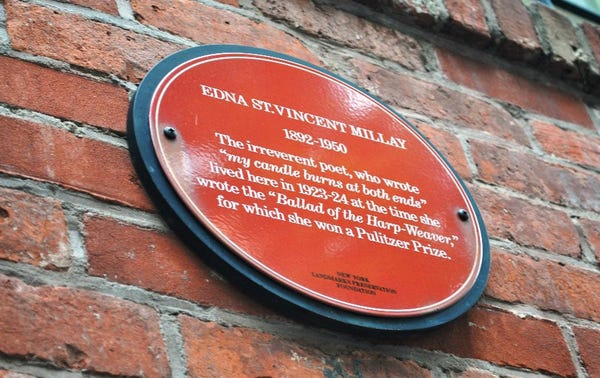
    Famous past residents include Pulitzer-winning poet Edna St. Vincent Millay, actors Cary Grant and John Barrymore, and cartoonist William Steig.

    Edna Vincent Millay
    Poet Edna St. Vincent Millay stands in Washington Square Park, 1941. Alfred Eisenstaedt/The LIFE Picture Collection via Getty Images

    William Steig famously wrote and illustrated the picture book “Shrek!,” which was adapted into the 2001 movie.

    There’s even a plaque outside the home stating that Millay wrote her Pulitzer-winning poem in the home.

    75.5 Bedford Street - New York City - Narrowest Townhouse
    TOWN Residential Real Estate

    However, Elizabeth Barnett, the late literary executor of the Millay Society, contested this notion, telling am New York that Millay wrote “The Ballad of the Harp-Weaver,” while living in Europe.

    Since the 1800s, the home has seen major renovations, although some original features, like wood-beamed ceilings and Dutch doors, remain.

    75.5 Bedford Street - New York City - Narrowest Townhouse
    TOWN Residential Real Estate

    The more modern fixtures come in the form of updated appliances and marble finishes. Those updates were done by the previous owners to the current ones. But the current owner, Tandra Hammer, did make some changes.

    “We didn’t really do tons of work, we just kind of took it from there to make it more livable,” Calarco, Hammer’s daughter, told The New York Times.

    Although the home is narrow, it still boasts three bedrooms, two full bathrooms, and four wood-burning fireplaces.

    75.5 Bedford Street - New York City - Narrowest Townhouse
    TOWN Residential Real Estate

    The third floor has a writer’s studio, which was built in the 1920s when Millay lived there, and overlooks the street.

    The backyard is big considering how small the house is — it’s roughly 10 by 42 feet.

    75.5 Bedford Street - New York City - Narrowest Townhouse
    TOWN Residential Real Estate

    The backyard has a private garden with access to another garden that’s shared with neighboring homes, according to The New York Times.

    The current owner bought it for $3.41 million in 2023.

    75.5 Bedford Street - New York City - Narrowest Townhouse
    TOWN Residential Real Estate

    Hammer’s daughter lives in the home most of the year, according to The New York Times.

    Even though the townhouse is occupied from time to time, the mother-daughter duo flip homes and are looking for their next project.

    75.5 Bedford Street - New York City - Narrowest Townhouse
    TOWN Residential Real Estate

    “We love the city, and we love flipping old houses,” Calarco told The New York Times.

    “We’re ready for our next project,” Calarco added.


    Source link
  • How Google Is Disrupting Itself to Beat OpenAI

    How Google Is Disrupting Itself to Beat OpenAI

    It made for an irresistible narrative.

    The large, slow incumbent — in this case, Google — was caught flat-footed by a more nimble upstart by the name of OpenAI. It was the type of story Silicon Valley built its legend on.

    In Sundar Pichai’s first letter to shareholders in 2016 after becoming CEO, he said Google would shift to an “AI-first world.” Yet, in late 2022, a relatively unknown company suddenly pulled the rug from under Google’s feet. ChatGPT was an overnight sensation, and Google, which had long seen itself as the leader in AI, appeared to be lagging behind.

    In the years since, the search giant has acted quickly to turn things around. It quickly reshaped key parts of its business internally and made an aggressive push to inject generative AI into its core products.

    Its latest AI model, Gemini 3, launched this month to dazzling reviews. Crucially, Gemini 3 launched within Search — Google’s most prized business — on day one, a strong signal that after three years the company had gotten its ducks in a row.

    However, there are big questions that Google is still grappling with as it rebuilds its image in the age of AI. OpenAI’s first-mover advantage means that ChatGPT has become the “Kleenex” of AI — the name that everyone associates with it — and it will be tough for Google to change that.

    There are also more existential questions. Chiefly, how can Google preserve a healthy web ecosystem once AI has eaten the internet? To keep pace with rivals, Google is reimagining search not as a directory, but a conversation that removes the hassle of scrolling and clicking. What that means for the future of the internet is a lingering question. Still, Google’s business may not only survive its self-disruption, but thrive.

    “It has the users, and as long as it continues to rush out new products, no one can match its distribution tentacles,” a former Google executive said. “They will come out as winners no matter the scenario.”

    Google told Business Insider in a statement, “We’ve been through platform shifts before, and every time it’s been an expansionary moment for Google and for Search. We move quickly, innovate, and create new opportunities for our products, partners, and users — and that’s what we’re doing with AI.”

    Gemini rising

    Did Google see it coming? That depends on who you ask.

    When OpenAI’s ChatGPT rolled out, Googlers experienced a mix of frustration and relief. Some employees had worked on similar projects that had never made it outside Google’s walls, and seeing a much smaller competitor take the glory was frustrating. Others saw it as the starting gun in the AI ​​race and the green light for Google to finally unleash its own AI on the world.

    Google has never lacked brains or technology. Employees at DeepMind, an AI research lab within Google’s parent company, had been toying with large language models by the time ChatGPT appeared, but leaders worried that releasing a chatbot prone to bias or errors would spark backlash.

    “It was not intended as a public thing yet,” a former DeepMind employee who worked on Google’s own LLM technology said. “We saw shortcomings and saw it start to be interesting, but it was unclear how to get it to be completely useful.”

    What surprised some leaders inside the company — and where Google ultimately miscalculated, insiders say — was that users largely did not seem to care about ChatGPT’s shortcomings.


    Demis Hassabis and Sundar Pichai on stage

    In 2023, Google fused together two of its AI labs to focus on building Gemini.

    GLENN CHAPMAN/AFP via Getty Images


    Inside DeepMind, teams scrambled to launch their answer to ChatGPT, a chatbot named Sparrow, which would have had more safety guardrails than ChatGPT, according to people who worked on it. That project soon died once Google merged DeepMind with its internal AI lab Brain, and the company then put all its focus on Gemini.

    At the same time, Google made an internal push to infuse generative AI into all its most crucial products, including Search, YouTube, and Android. It launched multiple iterations of the Gemini chatbot, the latest of which is Gemini 3.

    Searching for Google’s future

    Over the past three years, Google has made disrupting itself look fairly easy. The company just reported its first $100 billion quarter. Its cloud business, which has long been second-fiddle to Amazon’s and Microsoft’s, is whirring into overdrive. Its specialized AI chips, for years an internal and slow-moving effort, are suddenly seeing blockbuster demand from companies seeking more computing power.

    Current and former employees say Google’s greatest advantage is that it owns the full technology stack needed to meet the AI ​​boom. It offers numerous products, including Gemini, Search, and Maps, which are already used by billions of people. It has a fleet of researchers building frontier AI models. And it has a cloud infrastructure that is not just powering all these internal efforts, but that its biggest competitors are paying to use.

    Search, however, remains Google’s core business and the boat it spent decades trying not to rock. When cofounders Larry Page and Sergey Brin started Google, it had no clear business model beyond building a world-beating search engine, but the founders were eventually swayed into putting ads into search results. It became one of the most scalable businesses ever imagined in the digital era, and to this day, it continues to provide the largest chunk of Google’s revenue.


    Google Search lead Liz Reid speaking on stage

    Google Search head Liz Reid.

    SAJJAD HUSSAIN/Getty Images


    Now, Google must figure out whether AI Overviews — its generated summaries that give users instant answers to their questions — and the more dramatic reimagining of search in AI Mode have as much juice when it comes to search advertising.

    Google can’t afford to stand still. Industry analysts at EMARKETER, Business Insider’s sister company, predict Google’s share of the search ads market will drop below 50% for the first time next year (a revision to their earlier prediction that it would happen in 2025). By the end of 2026, EMARKETER predicts Google will have a 48.9% share.

    EMARKETER senior forecast analyst Oscar Orozco said that the sustained high performance of Google’s search business suggests advertiser caution around AI Overviews has been “overblown” by the market.

    “However, this does remain a long-term threat for their search business, and we believe as LLMs monetize their search capabilities, Google will continue to lose share, albeit at a slower rate than we had expected at this same time last year,” he said.

    Google is reshaping the web as we know it

    Google, at least publicly, doesn’t appear to be worried.

    In a recent interview with The Wall Street JournalGoogle Search boss Liz Reid said that while changes to search resulted in reduced traffic to some websites, the overall number of search queries was increasing because Google made it easier for people to get to answers, either through AI Overviews or tools like Lens.

    “The increase in searches sort of compensates for the impact on ads clicks such that we end up roughly at the same point,” Reid said. She also made a point that chatbots can’t replace products users are looking to buy, hinting at a top priority for Google: transactional searches that are more likely to produce ad revenue for the platform.

    Even that is changing for Google. The search funnel — the time between someone starting to research a product to hitting “buy” — is shrinking, as generative AI gets people to what they want sooner.

    Google has begun to show the world how it’s adapting to protect its core money maker. However, it’s unclear what the generative AI boom means for the long-term health of the web, and how it will impact websites that supply information as opposed to products.

    Google says that its new AI search features can help users find more relevant content, and that queries continue to grow year-over-year. Yet many publishers already see search traffic decliningand there are growing anxieties that even if overall searches go up with AI summaries, they will not translate into website clicks.

    A recent Pew Research study based on the search history of 900 users concluded that when an AI Overview appeared, users clicked a traditional link 8% of the time, compared to 15% when an AI summary did not appear. Google said the research was flawed and not representative of overall search traffic.

    Lily Ray, vice president of SEO research firm Amsive, said that a shift to an AI-first Google would make it harder for publishers and content creators who build much of the web to make money. If people stop publishing, where will Google get the information it needs to construct its AI Overviews?

    “I’m not sure how they plan to solve that; their current excuses are not cutting it,” she said.

    One idea she suggested is that Google and other AI companies that build large language models pay commissions to the sites they train on or reference, as an incentive for them to keep creating.

    She’s not alone in feeling something needs to shift.

    “The business model of the web can’t survive unless there’s some change,” Cloudflare CEO Matthew Prince said in an interview with the Council on Foreign Relations earlier this year. Prince, whose business acts as a gateway between websites and the internet, has called AI answerbots an “existential threat” to the internet.

    “If content creators can’t derive value from what they’re doing, then they’re not going to create original content,” Prince said.

    Disclosure: Business Insider and its parent company, Axel Springer, have both sued Google over its advertising practices.

    Source link

  • With ‘the Running Man,’ Glen Powell Could Be the Next Tom Cruise

    With ‘the Running Man,’ Glen Powell Could Be the Next Tom Cruise

    He has matinee idol looks, can deliver convincing performances in any genre, loves doing his own stunts, and, boy, can he run fast!

    No, I’m not talking about Tom Cruise — I’m talking about Glen Powell.

    In an era where genuine movie stars are becoming endangered species, Powell is making the case that they can and do still exist. And his training comes from one of the best.

    Although Powell got his first acting role more than two decades ago, he rose from relative obscurity to the latest “It” actor in Hollywood after starring alongside Cruise as Lieutenant Jake “Hangman” Seresin in the 2022 blockbuster hit “Top Gun: Maverick.”

    Soon after, he solidified his sex symbol status starring opposite Sydney Sweeney in the 2023 rom-com “Anyone but You,” which brought in over $220 million in theaters worldwide and helped revive the rom-com genre at the box office. Then came a blockbuster and a TV series (2024’s “Twisters” and Hulu’s “Chad Powers,” respectively), which proved Powell can carry projects on both the big and small screen.


    Glen Powell holding onto a taser stick in The Running Man movie

    Glen Powell in “The Running Man.”

    Paramount Pictures


    But if Powell is to ascend to Tom Cruise levels of superstardom, he’ll first have to nail his gutsiest move yet: becoming the face of a remake of a movie that first starred one of the biggest actors of the 1980s: Arnold Schwarzenegger.

    If anyone has faith that Powell can pull it off, it’s Edgar Wright, who directed him in his new film “The Running Man,” in theaters Friday. He said he caught Powell at the perfect time to play the original Schwarzenegger role of Ben Richards, a man who enters the titular lucrative-but-deadly game show in hopes of using the prize money to get him and his family out of poverty.

    “The studio had a list of people — these are the types of actors that we would greenlight this movie with,” Wright told Business Insider. “Glen was the one person who I thought, ‘That’s our guy.’”

    Despite his rising status in Hollywood, Wright said Powell’s down-home appeal made him right for the role.

    “To me, he can still play the everyman,” Wright said. “So when I saw Glen’s name on the list, I was really excited.”

    That everyman quality may soon be harder to come by honestly, especially once “The Running Man” hits theaters. Powell is magnetic, and he’s in almost every shot — not to mention he did many of his own stunts (sound like anyone else we know?).

    “He wanted to do as much as he could on camera, and I know he learned that from Tom,” Wright said of Powell’s stunt work in the movie. “I think Tom was probably the first phone call he made when he got the gig. Well, I know he did (call him) because he was asking about advice on how to do your own stunts and running.”


    Tom Cruise handing on the landing gear of a plane in flight

    Tom Cruise in “Mission: Impossible – The Final Reckoning.”

    Paramount Pictures


    Powell may have taken cues from Cruise’s stunt work, but he’s followed his playbook for fame more astutely in other ways. He hasn’t played a superhero (yet), choosing to focus on projects in which the biggest known quantity involved is himself or other actors — not fictional characters. Like DiCaprio and Timothée Chalamet, he also hasn’t attached himself to a years-sucking franchise (something Cruise has done with “Mission: Impossible,” though arguably he’s succeeded in making that series more about his personality than the source material). He’s putting butts in seats and proving he can be a bankable star based on the strength of his personal brand alone.

    The buzz around Hollywood is that executives can’t get enough. One studio head I spoke to earlier this year, who has worked with Cruise for many years, couldn’t stop gushing about Powell.

    Powell clearly excels at this social game within the business. Not only will it keep him employed, but it will also bring him to a higher level of movie stardom — as long as his performances can continue to back it up.

    Powell has said that no one will ever replace Tom Cruise. But the reality is that Cruise is 63 and can’t hang on the side of airplanes for much longer. I’m not saying Powell has to do it exactly like Cruise, but in a time when Hollywood is desperately searching for new superstars, perhaps using Cruise’s path to forge one’s own isn’t a bad idea.

    “The Running Man” is in theaters on Friday.

    Source link