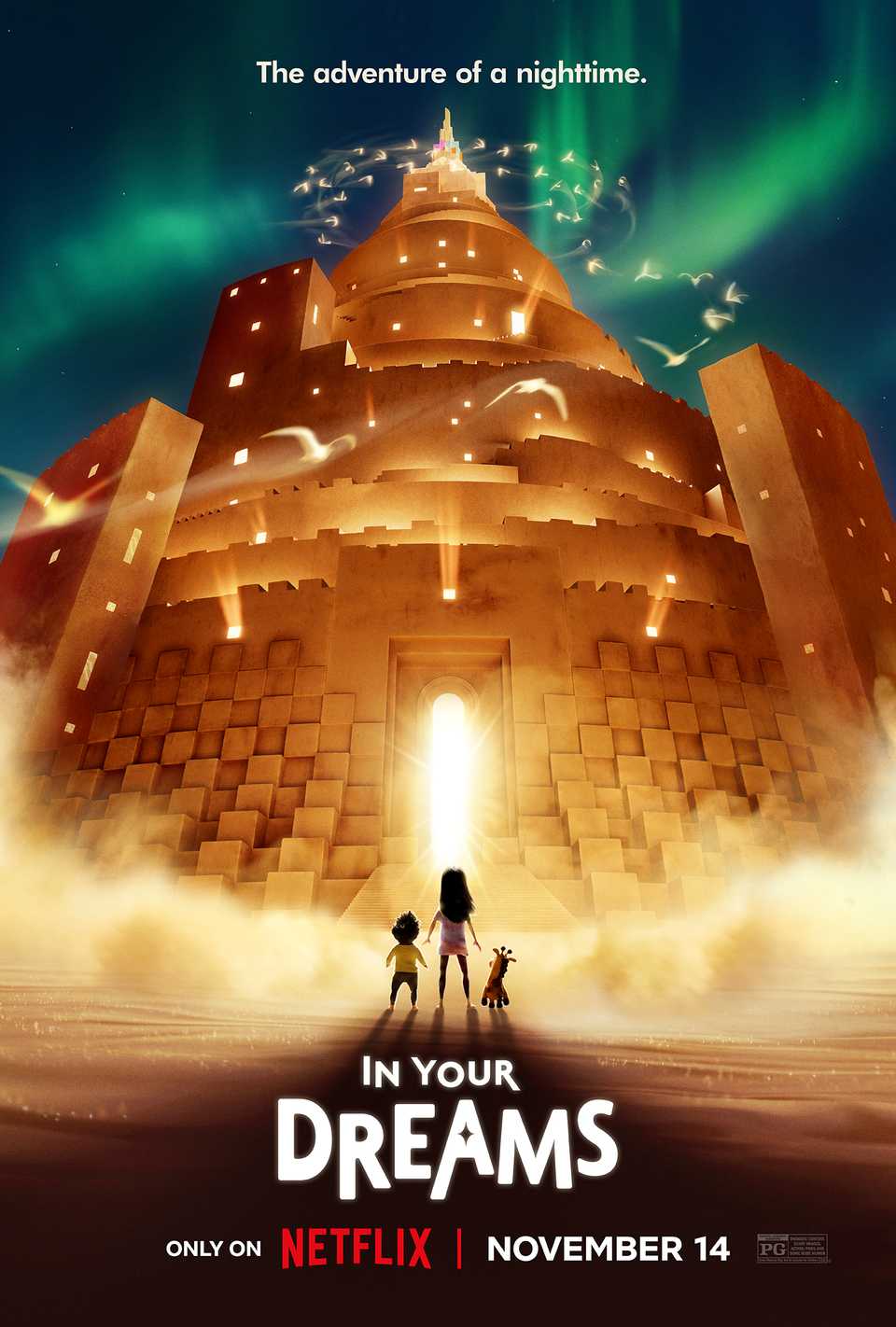
Warning: Some SPOILERS lie ahead for In Your Dreams!After having brought their adaptation of the DC/Vertigo take on the character, Netflix has found their next version of The Sandman with In Your Dreams, and co-writer/director Alex Woo assures they’re more than a straightforward villain. The animated film centers on Stevie and Elliot, two siblings who find their family in a difficult position as their parents are on the verge of divorcing. In an effort to keep their family together, the pair find themselves journeying to the land of dreams to meet The Sandman and wish for their parents to stay together.
With an ensemble cast including Craig Robinson, Simu Liu and Cristin Milioti, In Your Dreams pulls the rug out from under audiences halfway through the film as The Sandman is revealed to be the movie’s antagonist, only giving people dreams that come true, which leaves people in comatose states. Stevie, after falling into said coma to embrace the fantasy of a perfect life, narrowly escapes The Sandman’s dream with the help of Elliot and their parents, who learn of the magical book that started the whole adventure.
Ahead of the movie’s release, ScreenRant‘s Ash Crossan and Liam Crowley interviewed co-writer/director Alex Woo, Simu Liu, Craig Robinson, Jolie Hoang-Rappaport and Elias Janssen to discuss In Your Dreams. In reflecting on the Netflix movie’s depiction of The Sandman, taking a Wizard of Oz-like approach to the mythical being, Woo acknowledged that both L. Frank Baum’s novel and the Wicked Broadway show were inspirations for said approach, particularly in balancing the character’s potential evil ways with a more “well-intentioned” mentality:
Alex Woo: I watched the Wicked Broadway show when it first came out, and I was blown away. I’m obsessed with that musical, but you’re right, he’s not evil. I think the best villains are always well-intentioned, at least in their own minds. I don’t think anybody, well, maybe there are some people that are really malicious and evil, but I think most evil is really just misguidedness, where people think they’re doing something really good for another person or for society, but it’s actually not right for that person or society. And it’s kind of misguided. And that’s how I saw The Sandman.
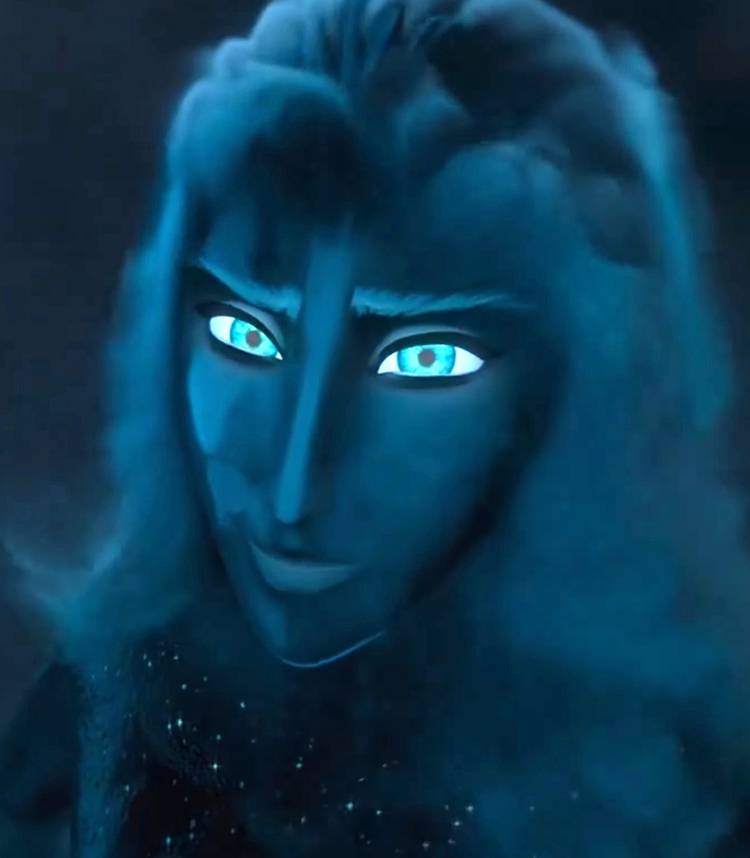
Nightmara looking toward the camera in In Your Dreams
One of the key goals Woo had for the film — which has garnered largely positive reviews and secured an 86% “Certified Fresh” approval rating from critics on Rotten Tomatoes — was to “change the charge on dreams and nightmares“. While acknowledging that the former allows people to “find fulfillment in life“, as well as push them to “innovate and push boundaries” in their lives, the co-writer/director also expressed that solely focusing on a dream can “cause a lot of damage“.
As such, he wanted to “temper that a little bit” for younger audiences, which led to his making The Sandman as In Your Dreams‘ antagonist, given he was envisioned as “this misguided villain“. This also opened the door for Woo to “flip the charge” on nightmares from solely being viewed as “a negative thing“, especially as his confronting his own in the past has led to some of the best things in his life:
Alex Woo: In my life, so many of the most challenging things that have happened to me that seemed like nightmares at the time are the things that shaped me the most and the things that I’ve learned the most from, and I’ve grown the most from. And so, yeah, I thought nightmares, sometimes they get a bad rap. We got to have people look at it from a different point of view.
Woo went on to explain that this foundation for the story made In Your Dreams‘ ending “very hard for us to land” during development, as the co-writer/director knew that Stevie couldn’t “get everything she wanted“, as it wouldn’t be true to reality. Calling such an ending “saccharine” and “dishonest“, Woo also shared that he wanted to avoid it being “a tragedy” by the movie’s conclusion, thus trying to find a balance, which proved “really, really tricky” to pull off:
Alex Woo: I think it does give audiences that mixed emotion of bittersweetness. It’s hopeful, and it’s optimistic, but it’s not everything that she wanted. And that’s kind of the message of the movie, that life, the messiness of life can oftentimes, and it is often better than anything that you could dream up yourself. And I found that to be true in my own life. And I think most people who have lived through life find that to be true. And so that’s what I wanted to impart on audiences, and hopefully it’ll help them get through the messiness of life, of their own lives.
In Your Dreams Is One Of A Few Projects Woo Wanted To Leave Pixar To Make
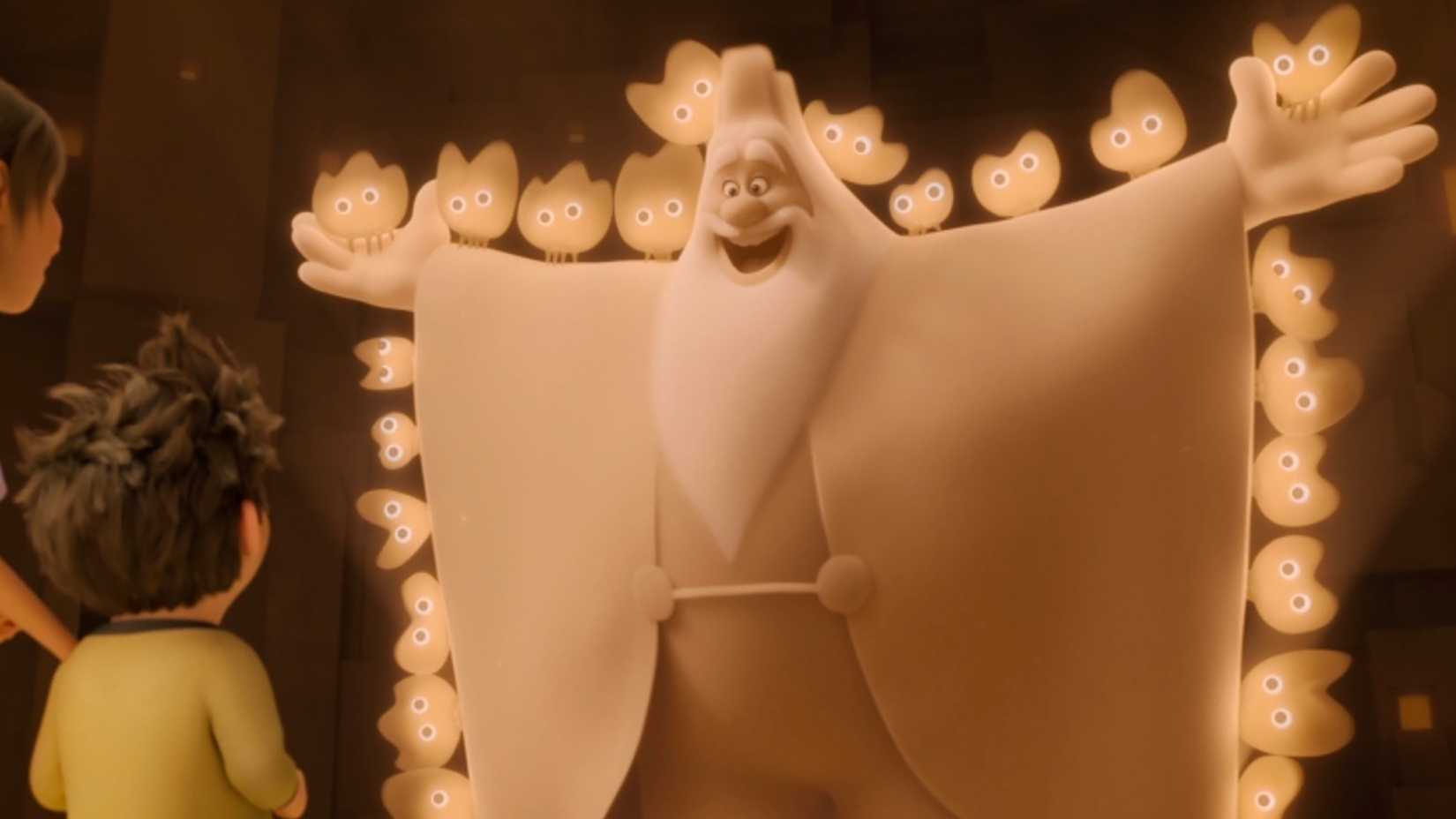
Sandman greeting Stevie and Elliot with his minions all over his body in In Your Dreams
ScreenRant: I know that this picture has been in the works in your mind for close to a decade. Can you talk to me about this whole journey of scripting it, the notes that you left on a pizza box, getting from there to pitching it to Netflix to COVID, how did this thing come together?
Alex Woo: Yeah, well, I used to work at Pixar. I worked there for about 10 years, from 2005 to 2015, and then I kind of got the itch to jump ship and try something on my own. And so in 2016, I left the mothership and I tapped two of my friends on the shoulder who also worked at Pixar, and we started our own independent animation studio called Kuku Studios. And we spent the first year just sort of dreaming up TV shows and movies that we wanted to see that we felt like nobody else was making. And one of those ideas was In Your Dreams. We really wanted to make a movie, an animated movie in the dream world, because we felt like that space had not been explored, especially in western animation.
So obviously you have Inception in live-action, and then with anime and Japan, you had Paprika and a bunch of other fantastic feature films that explored the world of dreams. But as far as American animation went, they hadn’t really done it yet. And so we thought it was a wide open space, and it’s such a universal human experience, and dreams are so magical, we still don’t really know why we have them, and they take you to this other dimension. So we felt like it was perfect for an animated feature. Now the problem is I think with the dream world, anything can happen, which makes it really creatively enticing, but when anything can happen, nothing means anything. So the problem with dream movies is always giving them stakes.
And so we had to figure out how to ground this story, this really fantastical story with something really relatable and really intimate and personal. And so that’s when I remembered this thing that happened to me when I was a kid. I was maybe six or seven years old, and I woke up one cold Minnesota morning and my mom had her bags packed, and she was standing in front of the front door of our house and me and my brother were like, “Wait, well, what’s going on here?” And she had to sort of gently explain to us that she was going away for a little while to sort of figure things out for our family and for herself.
And I remember watching her leave, and I remember watching her pull out of the driveway, and I remember feeling like the only thing I wanted in that moment was to find a way to keep my family together and save my family. And so I told this story to my partners, and they’re like, “That’s really juicy.” It’s so relatable, it’s so vulnerable, and it’s so rootable, just to want to save your family and keep your family together from a kid’s point of view. So, we decided to pair that small, intimate, personal story with this big, fantastical, adventurous world of dreams, and that’s where In Your Dreams came from.
ScreenRant: Before we get too into the nitty-gritty of the film itself, you mentioned your production studio that you started, Kuku Studios. There’s kind of a twofold meaning to the name Kuku. Could you share that?
Alex Woo: Yeah. So first of all, leaving Pixar to start your own independent animation studio is a little crazy, but we thought Crazy Studios doesn’t sound great. So we thought Kuku is fun, but really “ku” in Chinese means cry. And I was very inspired by these Greek theater masks. The Greek drama is sort of like the root of all drama, but you have the tragedy mask and the comedy mask. And so those are the types of stories that we want to tell as a studio, which are stories that make you cry, tears of laughter and tears of pathos. We want you to be laughing so hard that you’re crying and feeling so deeply that you’re crying. So yeah, that’s the etymology of the name of our studio.
ScreenRant: Can you talk to me about the connective tissue you placed between the real world and the dream world and how everything in the dream world needs to be at least some semblance of something that happened in these characters’ personal lives?
Alex Woo: I mean, that was based off of our sort of decision and commitment to try and make everything in the film feel authentic. So when we started the movie, we gave everybody dream journals. So they would write down all the dreams that they had, or at least the ones that they could remember.
ScreenRant: Your cast members?
Alex Woo: No, our crew. And so a lot of the dreams, almost all the dreams in the film were either directly or indirectly inspired by the entries into these dream journals. I mean, a lot of ’em came from me, a lot of ’em came from Eric. But we really wanted that sense of authenticity and to make it feel like what dreams actually are like for the audience and the connection from the dream world to the real world. That was actually the key that unlocked the story of this film. So I told you about that personal story that I had, and then the dream world, we didn’t know how to connect those two things. And when I came up with the idea that if you could find the Sandman in the dream world that he could make your dreams come true, suddenly the real world in the dream world were now intimately connected, and what you did in the dream world could affect the real world. And so that’s really what helped us crack the movie.
ScreenRant: How does it feel that this film is coming out now? When Cristin’s winning Emmys, Simu just wrapped production on Avengers: Doomsday. This puts a level of prestige on In Your Dreams, something you couldn’t have planned for.
Alex Woo: Yeah, I mean, we just feel so lucky, and I’m so happy for them, and I’m so proud of them, even though I had nothing to do with their success, but just as an admirer and a fan of them and their work, it’s so gratifying. With Simu, when we cast him, he had finished filming Shang-Chi, but I think they delayed it because of COVID, so the movie hadn’t come out yet, and I didn’t really know about him. We have a mutual friend, actually, that when I was looking to cast somebody, I wanted somebody who was of Chinese descent, and there weren’t a lot of actors at that point that were ethnically Chinese that had done a lot in the states. So, my friend heard about what I was hoping for from a casting standpoint. He said, “Hey, you should really think about this guy, Simu Liu.” And I was like, “I don’t know him. What has he done?” And he showed me Kim’s Convenience. So I watched that, and I was like, “Oh, this guy’s super charming, and he’s got comedy chops.” And then he told me that he was going to be Shang-Chi, and I was like, “Oh, that’s a huge role. He’s probably going to blow up after that.” So I met him over Zoom, and we had a conversation and I just thought he was so charismatic. Obviously, he is very charismatic, and that’s exactly what we needed for Dad, because in some ways Dad is holding onto his dreams of being a musician. Those dreams aren’t really panning out. So, in some ways, you could see him as a deadbeat dad, but because of Simu’s charm and his charisma, you don’t hold it against him. You actually want him to succeed, and you want him to keep holding onto his dreams, and setting an example for his kids that you should never give up. So that was critical. And on top of that, I dunno if you know this, but Simu sang in the movie.
ScreenRant: Yeah, I was going to bring that up. If my timelines are correct, you got him singing before he was in Barbie?
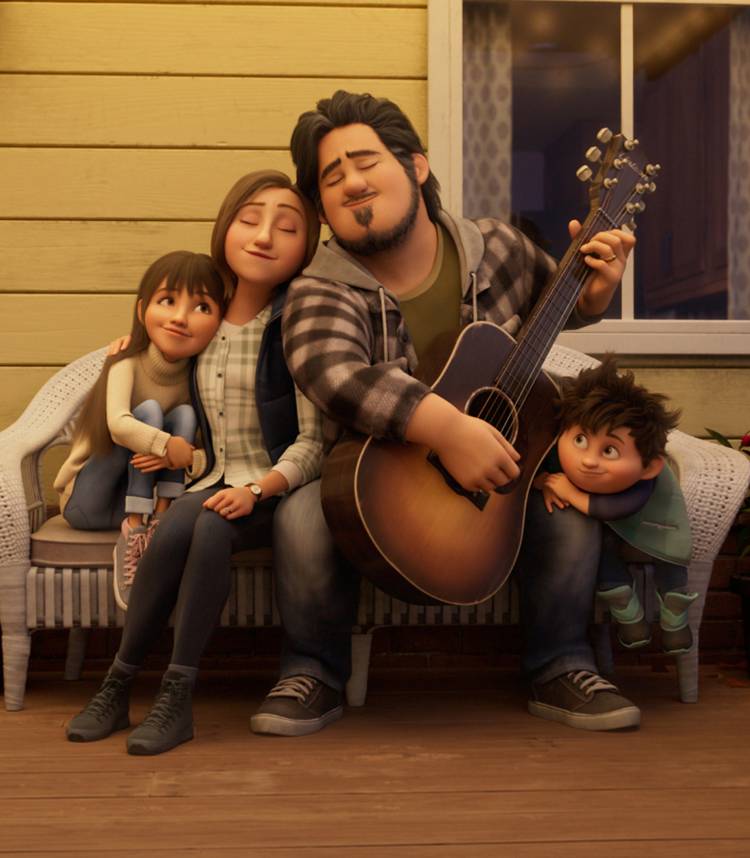
Simu Liu as Dad performing his guitar with the family snuggled around him in In Your Dreams
Alex Woo: Yes, I did. So that was actually a critical piece of the audition process, and I just asked him, I said, “Hey, your character’s a musician, and we have a song in the film, can you sing?” And he’s like, “Yeah, I love singing. Nobody knows that I do it, but I really love it.” So he sent me a sample of one of the songs that he recorded, and I was like, “Wow, this guy’s really good.” And so I was really excited to actually showcase that aspect of his talent. So that was phenomenal.
And then, with Cristin, I’ve been a fan of hers since my first job when I was still in college, I worked on this show called The Venture Brothers. So in The Venture Brothers, it is this show on Adult Swim — I think it’s been maybe eight seasons or nine seasons. It’s over now, but it was the first job I had while I was still in school in animation. She did a couple of voices for that show for different characters, and she had just had so much range, and I just thought, “Who is this person? She’s so talented.” And then she did Once, and then she did How I Met Your Mother, and then she did Palm Springs and Black Mirror, and I’ve just been a fan of hers ever since, and that she can sing nobody’s business.
I think she did a cover album. For Once, she won a Grammy for that, for a performance on that. And I think she did a cover of Bon Iver, one of his albums. So, she’s just so versatile as an actress and as a performer, I keep saying that she’s like an EGOT-level talent. She’s already got two, she’s only got two more to go. So, yeah, we were so lucky when she agreed to do this, she’s so picky with the roles (she takes), and I think it speaks to her sort of artistic integrity. I felt so lucky that she agreed to be in our film. It was such a vote of confidence for me as a filmmaker.
ScreenRant: Baloney Tony voiced by the wonderful Craig Robinson. Can you talk to me about the half-and-half design that you went with? Because I know that there’s kind of a story behind what we see on one side versus the other.
Alex Woo: We didn’t really think about it as a half-and-half design, but we wanted Baloney Tony to look like one of those well-worn, well-loved stuffed animals that —
ScreenRant: Do you have one from your childhood?
Alex Woo: Not anymore. I’ve had to throw it out.
ScreenRant: What’s the stuffed animal, and what’s the name? I always love to know these things.
Alex Woo: So the idea for Baloney Tony came from my brother and I. We used to have these matching pair of teddy bears. They were called Santa Bears. And my aunt bought them for us one Christmas, and they’re these white, they kind of look like polar bears, and they have this knit red-and-green Christmas hat. They were really adorable. And my brother, when he was young, he sometimes had bloody noses, and he bled on one of his bears, and it’s near the tail, so it looked kind of like a butthole. So we called him Butthole Bear. So that was the name. But, of course, it was his Butthole Bear, so he loved it despite it being gross and bloodstained. And there’s something just so sweet about that I think every one of us has that, a doll that’s past its expiration date, but it means so much to us, and it gives us a sense of familiarity and a sense of home. So that was where the inspiration for Baloney Tony came from.
ScreenRant: The post-credits scene you included here, I don’t want to say crushes that idea, but it kind of dispels my thought he was going to keep the book, and then we’re going to go off and kind of take this in an anthology route. Do you want to visit this family again? Or if you’re going to do an In Your Dreams sequel, would you go an anthology route, go with a different family, a different set of circumstances, stuff like that?
Alex Woo: I mean, first of all, the button, we just thought it was so funny to undercut the audience’s expectations that we were suggesting that we were going to go into an anthology or some sort of sequel because, yeah, so many of these Marvel movies do that right at the end of the day. They have this little button, and they set up the next movie, and we thought, “Oh, let’s play off that idea. Let’s lead the audience to think we’re setting up another movie and then just undercut it.” We thought it’d be super funny. And I think it is, but we always get a laugh in that moment. It doesn’t close the door to sequels. I love this movie. I love these characters. I love the world. There’s so much more to explore in the dream world. But whether or not we get a sequel, I dunno. I think we’ll have to ask Netflix.
Simu Liu Has Some Surprising Sympathy For A Classic Disney Villain
ScreenRant: I loved this movie. I thought it was adorable. A heartwarming, charming, but I also did not expect how funny it was. My favorite moment is when they go to, I think, Polly’s Pizzeria, I think what it’s called, and the animatronics are singing “Don’t Cha” by the Pussycat Dolls. Which leads to my question: what is your number one karaoke song?
Simu Liu: Wow. A lot of pressure. A lot of pressure. You know what changes is I love a good R&B ballad, so I think John Legend, “All of Me”. I think that’s up there. If I have a lady with me, then we’ll probably do “Shallow”. But I can only do one part of it. I like to think that I can (sing). The good thing about karaoke is you have a completely captive audience.
ScreenRant: What is the number one recurring dream that you have had?
Simu Liu: Yeah, I know it very clearly. There’s always a test, or an exam that I haven’t studied for that I forgot existed, and it’s happening tomorrow or in an hour, and I just have no idea what it’s about. I’m also like my adult self, but I’m held back, so I’m in high school again. It’s always high school, it’s never college. And I’m always like, “Oh, you can’t graduate unless you pass this test or something!”
ScreenRant: I know Baloney Tony. I love him. I have one. Sleeps in my bed with me. I thought of my childhood toy, they always had bizarre names. I had Pink Flamingo. Did you have one that you had to hold onto? Maybe it was given away at some point and you’re not over it yet?
Simu Liu: Sure, sure. Whatever toys I had as a kid, I feel like were just whatever we could afford from the yard sale. I remember I had parts of the Power Rangers, like Mega Swords that weren’t fully assembled, and at one point I had a He-Man with no head. So it was almost like Sid from Toy Story. I had to piecemeal together. That’s why I actually have a lot of sympathy for Sid when I watch Toy Story, like clearly his family, he is just trying to make do with what he had, and he was trying to let his imagination run wild in his own way. Actually, as I go back, Sid was maybe a little bit more violent about it than I would’ve been, but there is an element of trying to make it work, right? So I think my headless, He-Man Doll was my favorite.
Craig Robinson Has A “Rollercoaster”-Like Recurring Dream
ScreenRant: I have to say, one of my favorite moments is when they go to Polly’s Pizzeria and the animatronics are singing “Don’t Cha” by The Pussycat Dolls. Which leads me to the question, what is your go-to karaoke song? Set the scene.
Craig Robinson: Oh, yeah, yeah, yeah. Okay, Saturday night crowd’s hot, I might rock out “Time is Running Out” by Muse.
Jolie Hoang-Rappaport: Honestly, I get stage fright, and I don’t want to perform, but I remember back when I was really little, I would sing “Titanium.”
ScreenRant: Oh, that’s a good one.
Jolie Hoang-Rappaport: Yeah. It was intense. For some reason, I don’t know why I chose that, but I did. (Laughs)
Elias Janssen: My family’s done a couple karaoke nights, and I don’t know why, but “Careless Whisper” is always fun to sing. I know almost all the lyrics just off the top of my head.
ScreenRant: I love Baloney Tony. I have one. He sleeps in my bed with me, but it led me to think about, I had my childhood toy. I had Pink Flamingo. Did you have something like that, that had an obscure name, couldn’t get rid of it, maybe a parent gave it away, and you didn’t know, and you’re still devastated over it?
Craig Robinson: I had this gray teddy bear, Dontavius.
ScreenRant: What happened to Dontavius?
Craig Robinson: He’s in storage.
ScreenRant: He’s in storage, okay, so he is still okay.
Craig Robinson: Yeah, he’s still around.
Jolie Hoang-Rappaport: Apparently, according to my parents, I had this stuffed frog that they asked me the name and I clearly didn’t have a name, so I made it up on the spot, and I was like, “His name is Hachor,” so his name was Hachor. (Chuckles)
Elias Janssen: All my stuffed animals had real basic names. Just the name of the animal with a y at the end. Froggy, Beary. (Laughs)
ScreenRant: What is the number one recurring dream that you’ve had? There’s always, like, teeth falling out, I missed a final.
Jolie Hoang-Rappaport: See, I don’t have recurring dreams, but I feel like the similar theme is just that if I’m socially anxious, or I have a deadline coming up, I’ll be thinking about that in my head. I’m mapping out these conversations, I’m writing my essay, and then I wake up, and I’m like, “Dang, I didn’t actually do it in real life, and now I have to go do it, and maybe I should also just chill.”
Elias Janssen: I can’t really think of any dreams, like recurring dreams that I’ve had over and over again. I don’t really remember much in my dreams, but the ones that I do wake up and remember, I usually get something in those dreams and I wake up, and I’m like, “Oh, why don’t I have that in real life?”
Craig Robinson: I have this one dream where I’m in the car riding, and it goes up, and it goes in a loop, like a rollercoaster, but it’s a car driving, so it’s terrifying because you’re upside down in the car, but in some kind of way I don’t fall. And then that’s all that happens. (Chuckles)
ScreenRant: What is a dream role that you have that you have not tackled yet that you’d love to do?
Elias Janssen: I think a dream role, it would be really cool to be in some sort of superhero movie. I dunno, someone like Spider-Man. I like him. I’ve always kind of wanted to be a superhero, it just seems cool.
Jolie Hoang-Rappaport: Absolutely. I was thinking of maybe doing a Ghibli Dub. I know Hayao Miyazaki said it’s his last movie, but he always says that it’s always his last movie, so maybe there’s another one, but I don’t know. I feel like honestly, the next animated project I have coming up that I’ve been working on has been a dream project, as well, so I’m just excited for that to come out. You’ll see soon.
Craig Robinson: I kind of want to do a role where I just go around kicking everybody’s butt. Throwing people through windows.
اترك تعليقاً