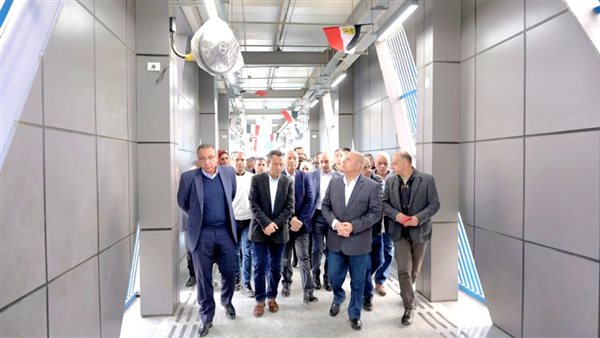
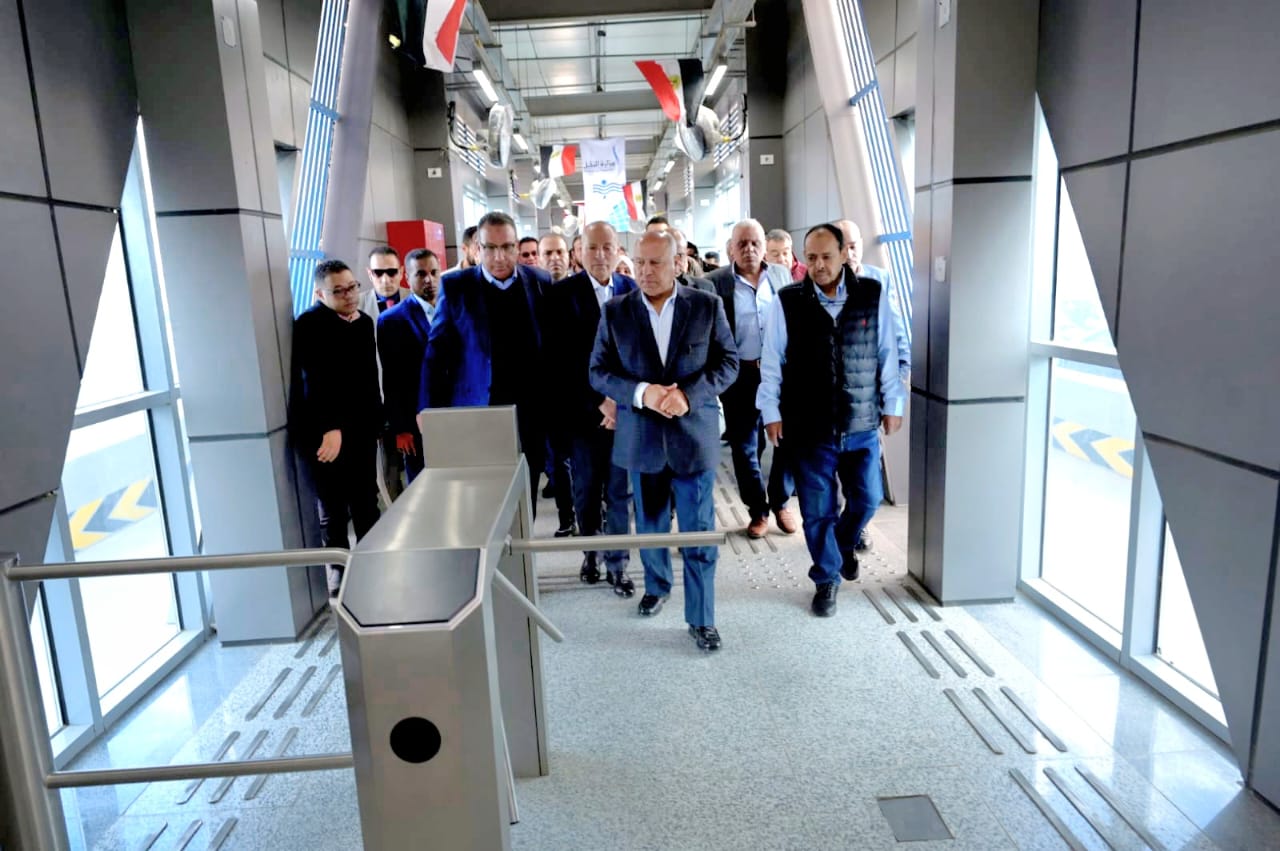
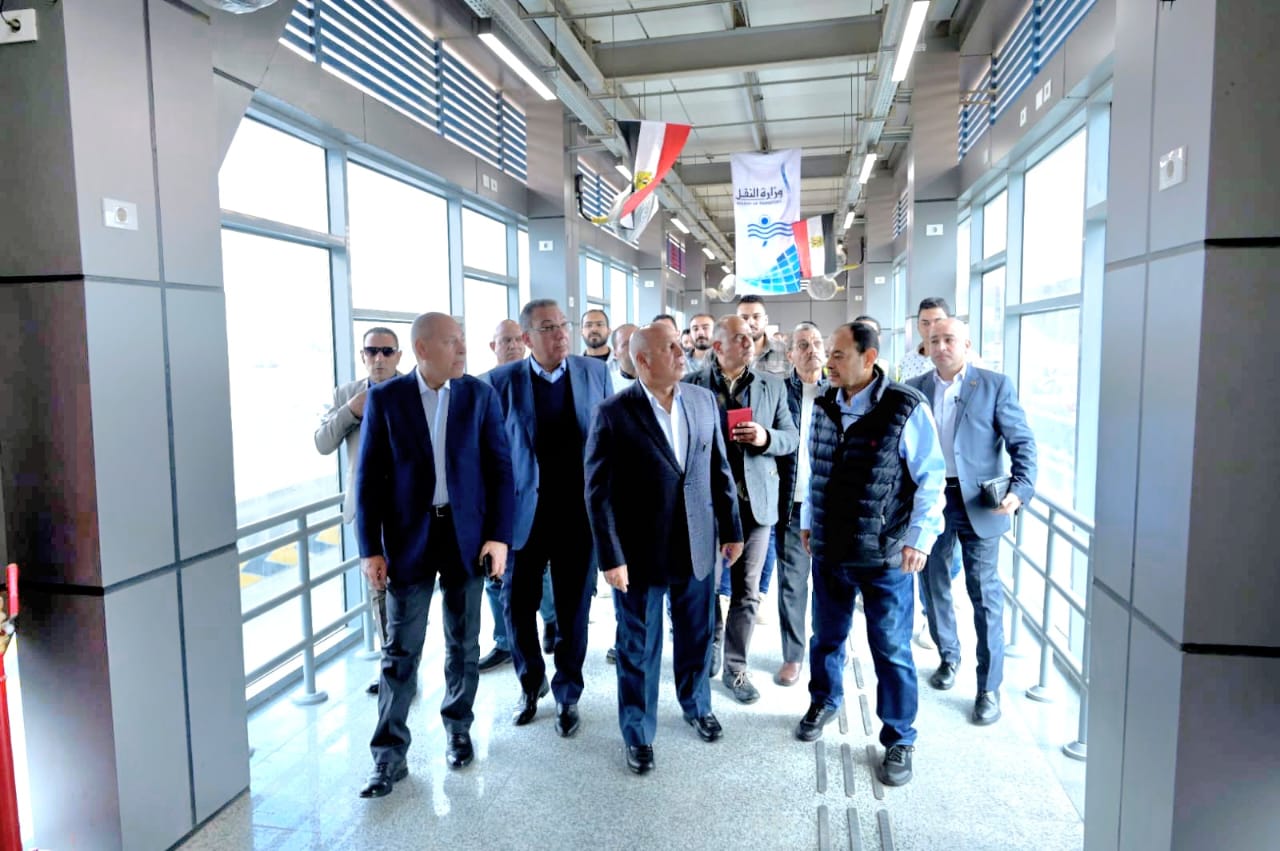
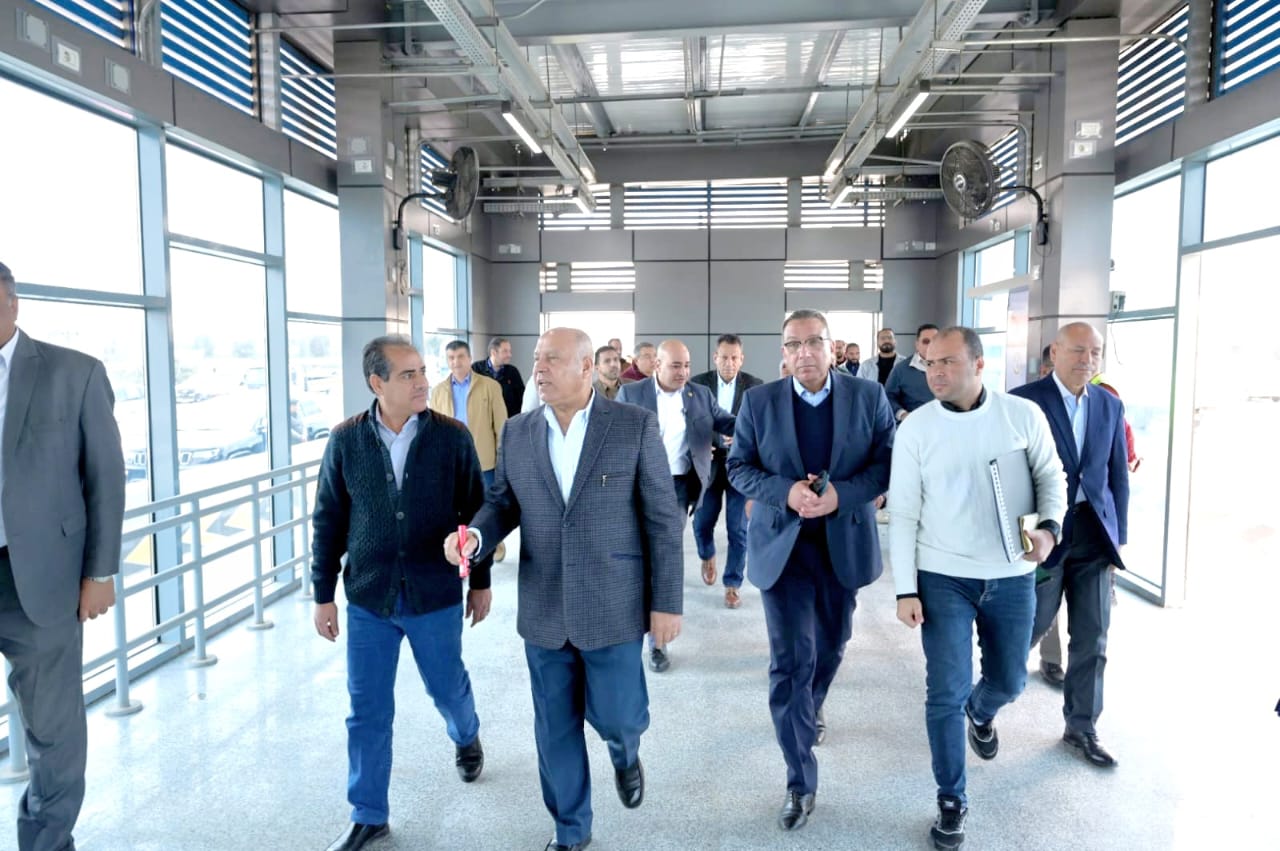
General Engineer Kamel Al-Wazir, Deputy Prime Minister for Industrial Development, Minister of Industry and Transport, accompanied by Dr. Ibrahim Saber, Governor of Cairo, Major General Majid Abd al-Hamid, Deputy Minister of Road Transport, Major General Tariq Abdul Jawad, President of the General Authority for Roads and Highways, the management of the Authority, the heads of the implementing companies and the project consultant, conducted an inspection tour to monitor the readiness of the first phase of the BRT bus project and inspect the work opportunities of the second phase of the project to develop the circular road around Greater Cairo.
The tour began with the minister inspecting the stations of the first stage of the bus project, which totals 14 stations (adly Mansour station “non-standard station” – number 2 surface station in Kobra walking distance “Bahtim and police academy” – number 11 surface station with walking distance) السويس” ) and from the total number of stations of the entire project, with a total of 48 stations.
During the tour, the working system of the transit bus and how to connect the project stations and the stops located below the ring road that serve those coming from and to the ring road, as well as how the passengers can reach the stations from those stops, whether through the overpass or the tunnels, until the independence of the transit bus, in addition to reviewing the waiting areas inside the stations and the ways to get tickets and traffic from the electronic bus gates, and the minister emphasized the regulation of the traffic from the station Adly Mansour بمشروع, BRT to the Adly Mansour central station, the interchange to facilitate the access of passengers to the light electric train, LRT, the third line for the metro, the Adly Mansour Al-Sweis railway line, and the subway station.
The Vice President of the Council of Ministers for Industrial Development, Minister of Industry and Transport confirmed that during the first and second stages of the BRT bus project, which will be operated on the main road around Greater Cairo, 100 electric buses will be operated with a capacity of 66 passengers per bus (5 microbuses) and will transport 3,200 passengers per hour in both directions. In the framework of the implementation of the directives of the President, Abdel Fattah Al-Sisi, the President of the Republic to work on the localization of various industries in Egypt, including the bus industry, and not to import any buses from abroad, as part of the comprehensive plan to promote the industry sector with the aim of turning Egypt into a regional industrial center.
adding that the BRT project will represent the patterns of civilization that the state seeks to achieve in the various projects that it implements, as it is a means of mass transportation that is environmentally friendly and will contribute to facilitating the movement of citizens within the framework of the plan to maintain order and traffic flow on the ring road, as well as aiming to eliminate random parking on the ring road, whether on the track, study or private houses on the road, and where it will contribute to preventing the entry of minibuses on the ring road and the new surface road along the ring road with The creation of surface parking spaces for minibuses to serve the express bus stations and to encourage and increase the public transport system by attracting new users of public transport instead of private cars, especially since these buses will provide the highest level of service to citizens in addition to protecting the environment by reducing the emissions from car exhaust, as all the buses that will be operated will be environmentally friendly electric buses.
Pointing out that the project will contribute to connecting the main intersections on the ring road, such as Al Suez Intersection, Adly Mansour Intersection, Al Marj Intersection, and Masturd Intersection, pointing out that this project is considered one of the main elements that will contribute to connecting the east of the capital to the west with the connection to the new administrative capital with one fast, civilized and clean means of transportation to integrate with other means of transportation, where it exchanges service with each – إمبابة) و ( القطر الالخفيف LRT في عدلى المصور منصور)
During his tour, the minister informed about the progress in the implementation of the second phase of the project, which is being implemented after 21 stations, and in the distance from Al-Mashir Tantawy to the Al-Fyoum intersection, including 3 stations along the Al-Haram – King Faisal – Tarsa and the Great Egyptian Museum station (Alexandria Desert), where the Deputy Prime Minister for Industrial Development, Minister of Industry and Transport, ordered the completion of all the stations of the second phase before May 30.
It is important to note that the BRT transit project around Greater Cairo includes 48 stations in addition to the main charging station + 3 sub-charging stations. It will be operated in three stages, the first stage numbering 14 stations, which includes the distance from Alexandria Al-Zara’i to the Police Academy, and the work will continue in the second stage, after 21 stations, in the distance from Al-Mashir Tantawy to the intersection of Al-Fyoum, including 3 stations along the Al-Muriotiya axis, Al-Haram – King Faisal – Tarsa and the station of the Great Egyptian Museum (Alexandria Desert), but the work will be completed in the stations of the third stage after 13 stations, and that is in the distance from Alexandria الزراعي حتى آسكندرية الصحراوى ونهو التعلقة بتلك الدائبة
During his tour, the minister presented the implementation rates of the second phase of the ring road development project around Greater Cairo, which includes the distance from the intersection of the ring road with the agricultural Alexandria road, until the intersection of the ring road with the Alexandria desert road, passing through the Al-Waraq bridge, where a new bridge will be built 2.25 km north and south to the side of the existing bridge, so that the road in this distance will be 8 lanes in each direction, and the partial maintenance work will be completed and prepared. مناسيب الخرسانة والاسفلت والفوازيلية والعرضية لكوبرى(٩ د), وتم فتحة امام هركة المرور عمل تعليقة عملة تعليقة الإسكندرية الصحراوي/ وصلة الواحات والمريوطية /المنصورية بجمالي 34 km.
Also, the implementation works of a number of the new traffic hubs being created to facilitate the citizens’ access to the ring road, such as the intersection of the Marj axis with the ring road, in addition to the implementation of the Al-Hadid road axis (Al-Algeria Street) in the section of Cairo Governorate in the distance from the intersection with the Al-Tunsi bridge to Arab Square and the works of the first stage of the Al-Mariutiya axis on the eastern and western banks of the ocean bank, which is 20 kilometers long, which connects the ring road with the middle ring road, which is one of the most important المحاور المرورية التي تخدم الحرقة النقط بنتاق المحافظة الجيزة
as well as the Deputy Prime Minister of Industrial Development, Minister of Industry and Transport, the progress in the implementation of the “surface” service road, which is 10 meters wide around the circular road from outside and inside, and the work of the intelligent transport system on the ITS roads, which achieves the highest levels of safety and security on the road.
The Deputy Prime Minister for Industrial Development, the Minister of Industry and Transport confirmed in a press statement that this visit comes within the framework of the directives of the President /Abd al-Fattah Al-Sisi, the President of the Republic, to expand the creation of a network of environmentally friendly, sustainable, green mass transportation and to direct it to form a higher committee of the relevant ministers, the governors of Cairo and Giza, and the officials of the relevant authorities regarding the preparation for the opening of the Great Egyptian Museum on July 3. The hour on the road to provide the highest level of service to the citizens and to appear in a special way in front of the guests of Egypt during the opening ceremony of the Great Egyptian Museum, which reflects the great renaissance witnessed by the transport sector in Egypt, including the road and highway sector during the reign of His Excellency President Abdel Fattah Al-Sisi, the President of the Republic, and the emphasis on continuous and round-the-clock maintenance of concrete barriers, pavements and road signs to increase road safety and cleanliness and the removal of construction debris. From around the clock and attention to the rental in the spaces available on the road and intensifying the work in the coming months to improve the visual image on the road and finish the second phase of the project before the next May 30 so that the first and second phases will be completed before the opening of the Great Egyptian Museum on the next July 3.
adding that the project of development and expansion of the Al-Dairi road is seamless in all respects and is carried out 24 hours a day, indicating that we are running out of time to finish the second phase of this project, and that the development, expansion and comprehensive maintenance works that were carried out in the first phase, which included the distance from Al-Mariûtiyah/Al-Munib/Al-Otostrad/New Cairo/Al-Salaam/Mistród/Askandriya Al-Zarai and the distance from the intersection of Al-Mansouriyah/Al-Fiyum/Intersection Al Wahat Road has a total length of 76 km. It has contributed to raising the level of service for road users, and accommodating the large volumes of traffic that flow on it throughout the day, in addition to reducing the travel time for road users, and reducing the energy consumption of vehicles, as well as limiting negative environmental effects, including the implementation of a plan for the optimal use of the spaces under the bridge and its use in the construction of parking spaces for minibuses and waiting areas for the BRT bus service, as well as the optimal investment use of BRT stations.
As did the team of Engineer Kamel Al-Wazir, Deputy Prime Minister for Industrial Development, Minister of Industry and Transport, accompanied by Engineer Adel Al-Najr, Protector of Al-Jiza, on an inspection tour of the first stage of the fourth line of the highway, which is being implemented under the instructions of His Excellency President Abdel Fattah Al-Sisi, the President of the Republic, to expand the establishment of green, sustainable, clean and environmentally friendly public transport, and where he was received by Major General Tariq Joyli, the head of the National Authority for Civil Aviation and the authorities of the Authority.
During his tour, the minister showed the project implementation rates, where the overall implementation rate reached 34.2%, where the construction works are currently being carried out at the stations and tunnel excavation works (tunnels in each direction) using 4 tunnel digging machines (2 machines in each direction), which have been completed by 64.2%. and the pyramids) and the completion rates were 52.8%, 50.2%, and 41.3%, respectively, showing that the restoration of the original object in the area surrounding the museum was completed by 87%; And these three stations will be finished from the surface before the opening of the Great Egyptian Museum on July 3rd.
As the deputy prime minister for industrial development and the minister of industry and transport explained that he is currently studying the implementation of the second stage, which is 31.8 km long and has 21 stations (6 underground – 15 tunnels) in the tunnel route, then it intersects with the sixth metro line “Al-Jari Drastha” at the Sayeda Aaisha station, then it runs through Basra Salah Salem, then Al-Nasr Road to Al-Azhar University, passing through Nasr City to exchange service with the Sharq Nile Monorail at the airport, then continuing in the direction The south-east until it intersects with the ring road at the security complex and the police academy, then it extends east along the left-hand axis after the police academy in the upper path until the first gathering in New Cairo, passing through the Al-Shabaab, Yasmin and Panfsj residences, then it goes north, ending at the location of the Al-Omrah workshop for the fourth line, north of the intersection of the ring road with the Cairo / Al-Suez road, the end of the second phase, which is the study of the implementation of the planned future branch of it up to the Cairo International Airport to exchange service in the future with the fifth phase من الخط إلى للمترو جرافي دراستها.
The minister explained the importance of working on the clock and the commitment to the timetable for the project of the fourth line of the metro; especially with its importance in connecting the city of the 6th of October and the new Cairo to the subway network; where it provides a service for transporting passengers to areas with high population density (Al-Haram, Faisal, Al-Umarniyah, Al-Jizah, Nasr City, Al-Azhar University, and New Cairo) adding that it is currently studying the implementation of the third phase of the line in the distance from the Al-Hadayek Al-Jejir station to the Al-Hosri Square, which is 16.3 km long to serve the population density along the route and to achieve the connection with the West Nile Monorail at the Al-Hosri station, as well as the implementation of the fourth stage of the line in the distance from the final station in the second phase Even the 38.7 km long capital airport station for connection with the LRT light rail (Adlı Mansour – 10th of Ramadan – administrative capital), stressing the importance of subway projects in achieving connectivity between different areas, facilitating the movement of citizens, which serves the development goals, noting that the line is expected to transport approximately 1.5 million passengers per day, after completion of implementation.
It should be noted that the fourth line of the metro extends for about 51 km, includes 38 stations (31 tunnels + 1 surface + 6 upper), and is implemented on two stages, the first stage of which is currently being implemented by the national Egyptian construction companies: نفقية + 1 surface) من غرب الترجيل الدايري على حودة مدينة 6 اكتبروة, passing through the Al-Masri Al-Kabir Museum station, then Meydan al-Ramaiyah, then Sharaa Al-Haram until Al-Jizah station; Where the passenger transport service is exchanged with the second line of the metro, then it extends after that until the Al-Malik al-Saleh station to exchange the service with the first line of the metro, then to the Al-Fstaat station in the old Egypt district.
Source link
اترك تعليقاً