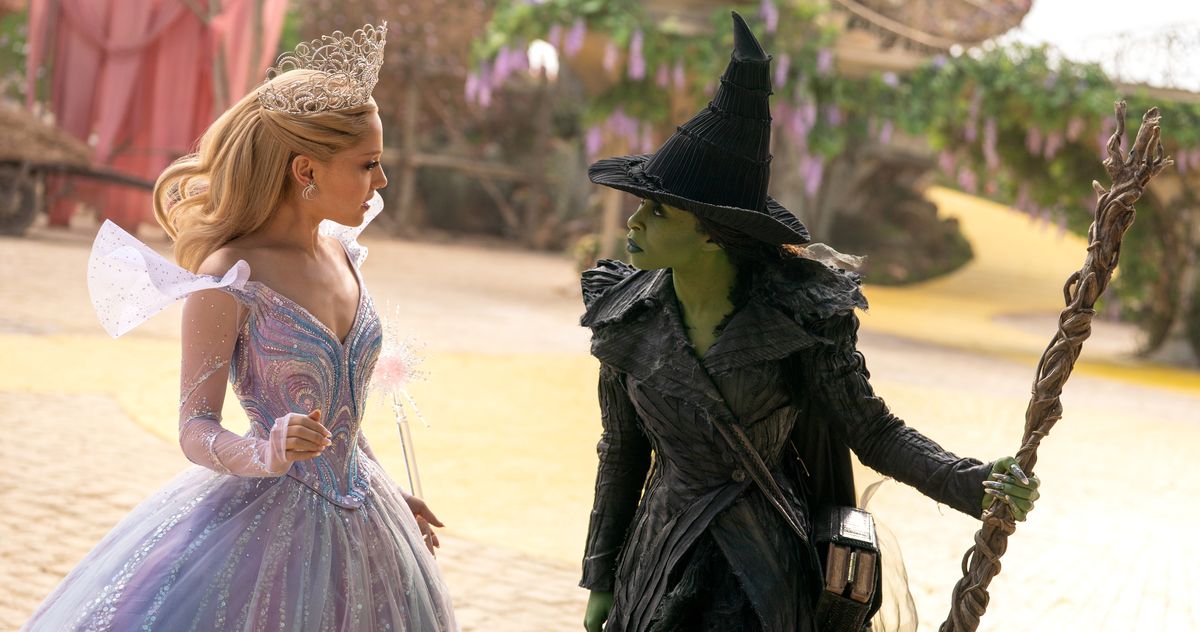
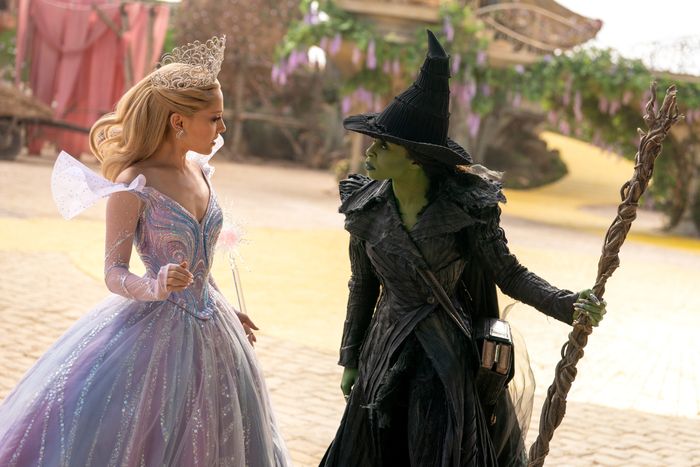
Photo: Giles Keyte/Universal Pictures
This is the latest edition of The Criticsour weekly roundup of critical reviews, essays, and conversations. Want to have it arrive in your inbox every Friday? Sign up here:
For better or worse, Wicked: For Good has hit theaters, bringing a definitive close to a sometimes confoundingsometimes surprisingand always emotional press tour. Director Jon M. Chu has spun an entire film out of the stage musical’s much shorter second act, beginning with Elphaba’s self-banishment from the Emerald City. For Good also adds two new original songs, one for each lead: Glinda’s heart-shattered ballad, “The Girl in the Bubble,” and Elphaba’s contemplative call to action, “No Place Like Home.” I sat down with theater critic Jackson McHenry and writer Rebecca Alter — also known as Vulture’s senior bucket critic — to go deep on the music in For Good. —Jasmine Vojdani, senior newsletter editor
Rebecca, you wrote about these two original songs when we had only 30-second or so clips of each. Did hearing them completely change your mind about how you felt initially?
Rebecca Alter: Even though the characters are having realizations over the course of the song, in both instances, they don’t sonically reflect that. They’re really boring. They didn’t change enough from those bits we heard — except that it felt like they both went on for quite a while.
Jackson McHenry: When they released the song list, I had questions about what they were supposed to add to the already convoluted plot of Wicked‘s second act. Elphaba’s song makes a little more narrative sense because you don’t hear a lot from her until later on in the show with “As Long You’re Mine” and “No Good Deed.” So you wonder about her emotional terrain as she switches from being at college to guerrilla warfare.
Glinda is already so much the focus of the second act of the show. “Thank goodness” has already done so much of the work there. It’s one of the more narratively effective songs in the show because it’s opening the second act, telling you what’s going on, allowing you to see her public performance and her private doubts simultaneously. But by the time we get to it “The Girl in the Bubble,” Stephen Schwartz hasn’t added much. Maybe a more well-crafted song that doesn’t just have lyrics about what a bubble is could do more.
Which vocal performance did you prefer in the new songs?
RA: Look, Ariana gets to do a couple of those high soprano notes in this, which are fun to hear in a it’s cool to watch someone do a backflip way. The hook that Cynthia does in “No Place Like Home” is a catchier hook.
JM: I personally have “girl in the bubble, the bright shining bubble” stuck in my head. That doesn’t mean it’s good, more that it’s so literal it’s funny.
RA: It’s another instance of this being Ariana’s movie thoroughly. Ariana singing to herself is more dynamic than watching Cynthia sing to the CGI animals.
Many of whom, as we’ve noticed, are Australian species.
RA: That’s the biggest bone I have to pick. Too many kangaroos. Is it because it’s Oz?
What felt like a missed opportunity musically?
JM: The character that would make the most sense to add a song for is Madame Morrible. She needs a diva moment even she’s summoning the tornado. She’s someone whose interiority doesn’t get filled out — she goes from being a teacher at the school to the press secretary for the king, or maybe she holds these jobs simultaneously? But anyway, it would be fun to have her let loose. The problem is Michelle Yeoh can’t sing, so you’d have to dub her or have cast someone who could really throw down. But the fact that there is more time spent on characters that are already filled out and not enough on the primary villain feels like a missed opportunity. Why does she want power? Maybe she, like Nessarose and Elphaba, was also an outcast and has made a choice about collaborating with the regime to get power, much like she wants Glinda to do. She can control the weather but still has decided to link up with the powerless wizard? There’s a story there!
RA: The thing about turning Wicked the musical into two entire movies is you could have had a bit more room to flesh out some stuff that doesn’t make sense onstage. You allow it onstage because things don’t have to make sense in the way they have to when you’re in close-up onscreen.
JM: It’s also a mistake that both the new songs are down-tempo.
RA: We needed another “Dancing Through Life.” “Wonderful” does not count.
Dare we go into the lyrics?
JM: I think we need to conduct a thorough investigation into the decision to use “unsee” in a song lyric in “Girl in the Bubble.” It feels simultaneously like an attempt to do an Oz-y word but also to sound current, which is a dangerous writing choice.
RA: No, because then it would be like “unsee-ify.”
JM: That would actually be better! “The Girl in the Bubble” is so committed to this one metaphor that it doesn’t really develop. “No Place Like Home” feels so prosaic. They’re both stuck in one idea. Neither one gets another step in its lyrical imagery.
RA: “A place that seems to be devolving and even wanting to” from “No Place Like Home” — that line sucks to be sung. But there’s something very Disneyish and warm to “if we just keep fighting for it, we will win back and restore it.”
Let’s talk about the original musical’s songs. Did you notice anything interesting about the movie’s approach to staging them?
JM: It’s crazy that they start with a megamix of the Act One songs. It’s sort of like doing an entr’acte with the orchestra doing the motifs, but instead it’s the characters doing it. It also sets the tone of “This is a silly movie,” which I appreciated. It’s so messy and beholden to the incentives of commercializing the product to be like, “We’ve got to remind these people of the first movie!”
RA: I like that they slow down early on to give Glinda her “Thank Goodness,” and she gets to be really intentional with how she phrases it.
JM: “Wonderful” is kind of an unsalvageable song, but the decision to include Glinda in it is interesting and gives an excuse for Ariana and Cynthia to be in the room together. But the movie devotes way too much time to that song. I also appreciated Cynthia’s riff on “Fiyerooooo” in “No Good Deed,” although the rest of that song tends to be more technically perfect than rawly head-banging and emotional. Also, that song is shot like it is set on an anti-gravity planet in a Guardians of the Galaxy movie. Ugly!
RA: Guardians of the Galaxy has musical numbers that are shot and staged better. “No Good Deed” is Cynthia’s time to truly shine, and the film puts her in her floating castle surrounded by these batlike monkeys flapping around her — I hate to see it. They also do this flashback thing where Elphaba’s walking through scenes from the first movie. The black-and-white footage of Fiyero getting beat up was some of the ugliest imagery I’ve seen in a movie in a while.
JM: If any song should be built around as few cuts as possible, it’s this one. Let her sell it in her face and her voice.
What musical moment landed the best for you?
JM: The reprise of “I’m Not That Girl,” by Glinda, which I think Ariana Grande sings heartbreakingly well. There’s so much attention paid to Grande imitating Kristin Chenoweth’s operatic soprano, which she’s good at, if not as bell-like and clear as Chenoweth can be with her signature high notes (hardly anyone is). But Grande has an underdiscussed rich lower register, and Glinda famously starts singing lower and lower through the show as she gets less fake and more real. It was fun to see Ariana go along that journey. And I love a reprise!
RA: I still get chills “For Good” where Glinda sings the lower harmony and Elphaba’s singing the upper one. They’ve been changed! And because it’s in close-up in the movie, you can focus on that. The first movie was at its best every time it was just Ariana as Glinda being in love — whatever type of love you choose to interpret it as — with Elphaba.
JM: Ariana has a great sad face. She flutters her eyelids really well.
RA: I judge male actors based on how they are look at a woman onscreen, how charged or deep it feels. How do they behold the girl? Ariana is randomly really good at pulling that off. She’s so good at looking at Cynthia.
How does she compare to Fiyero in that regard?
RA: (Laughs) I’ve never seen an “As Long As You’re Mine” like this. The chemistry is not there. It’s so fun and fabulous, but they’re not making eye contact. It reminded me of Twilightthis sort of failed intense fantastical eroticism. The intensity at which they’re trying to depict a romance with a lack of chemical reality is sublime in its own way.
What else did you want from the film musically?
RA: I would have liked Jonathan Bailey to sing more. And he doesn’t make a meal out of his lines that are supposed to be funny. This act of the stage show is messy, but some of these lines are still meant to be funny.
JM: Marissa Bode does a good job with “The Wicked Witch of the East.” Ethan Slater is good in that scene. People are mad that she doesn’t fully belt the climax online, but I’m fine with holding back there and letting Nessarose be more interior.
Jackson, you said you noticed something about Glinda’s apartment during “The Girl in the Bubble.”
JM: While disassociating from the lyrics of that song, I noticed her apartment looks like Padmé Amidala’s in Star Wars: Attack of the Clones. I just want it on the record that the Emerald City looks a lot like Coruscant. Also, that movie is George Lucas playing with genre film and sword-and-sandals/noir/detective/high-melodrama romance and having funwith it. Wicked: For Good actually could have learned a lot from Attack of the Clones! This movie is too often humorless and dutiful. The stage musical does more winking at itself.
RA: While writing about Fiyero having his own little Passion of the Christ off to the side during “No Good Deed,” I was watching an old recording of Wicked onstage. There’s a lot of laugh moments in the whole scene leading up to it. And it’s just played so dead serious in the movie, and that’s a wider issue. People in our screening audience were not laughing at the joke moments.
JM: There’s a way to be swashbuckling with it, to be old Hollywood, as in “we’re doing this, we’re having fun withit, but we’re not making fun of it.” I think a lot of blockbuster movies have gotten either too irony-poisoned or just entirely afraid of irony. There is a zone that is not diminishing the thing you’re doing but embracing the fun of being on this adventure in a sort of Errol Flynn or Gene Kelly way. Jonathan Bailey could play well but is not asked to. Ariana and Cynthia are so earnest, God bless them, although Ariana does have a lot more of a knack for humor. The genre can be silly and deeply emotional, not either/or, and those things can fuse into and fuel each other. I wish there were more of a sense of “Isn’t it fun that we got away with this?”
اترك تعليقاً